



THE drought-induced run-up in corn prices is a reminder that we’re nowhere near solving the problem of feeding the world.
Author: WHES
We won the War on Poverty, then lost the peace. If America could eliminate most serious poverty in the United States in the 1960s, surely we could do the same today.
When President Lyndon B. Johnson declared a war on poverty in January 1964, the poverty rate was over 19 percent. By 1972 it had fallen to less than 12 percent, and it stayed there for most of the 1970s.
Pat Kutzner And Helping People in the United States Understand People Who Are Poor and Hungry
This issue is in honor of Pat Kutzner, the founder of the World Hunger Education Service (WHES) 24 years ago and the editor for 20 years of Hunger Notes.
This issue is about development education, which was her life’s work, specifically, education about the poorest people in the world, who are hungry.
WHES and Hunger Notes are due to Pat, due to the people who have gathered together to support WHES and Hunger Notes, and, last but not least, to the people who are hungry. This issue is dedicated to Pat and is an appreciation of her. We begin with a note from Antonio Gayoso, who in recent years has become a WHES Board member and Chairman (based on his experience with Pat and her work), but who, in the events described in his note was a United States Agency for International Development official, who met Pat in his official capacity.
I met Pat Kutzner in the late 1970s, as the U.S. government prepared to participate in the United Nations Food and Agriculture Organization (FAO) World Conference on Agrarian Reform and Rural Development. She had been invited to be an NGO representative in the U.S. delegation to the Conference. Those were heady days for many of us, as the U.S. Government had become willing to modify its traditional position and endorse agrarian reform, including land tenure changes, as an acceptable option to bring about needed change in the rural sector in developing countries. My role was to coordinate U.S. participation.

Pat was very active in the discussions, always ready to contribute real human dimensions to the often-dry discussions and drafting efforts. In many ways, she constantly reminded us in the government that the objective of development assistance was to improve the lot of common people, who were usually powerless and often hungry. During the actual conference in Rome, she kept watch over the way in which the delegation carried out its now positive instructions, and actually published an issue of Hunger Notes noting who did the work and who did the touring of Roman ruins. Her comments had a salutary effect on workloads.
Once returned from the conference, Pat intensified her efforts to build coalitions to follow up with deeds the promises made in Rome. She organized a number of Praxis, (action-oriented development seminars) where she successfully attracted the participation of key policy makers and a large number of NGOs working on development and hunger issues. In addition, for more than 20 years, she was the soul and major support of both the World Hunger Education Service (WHES) and of Hunger Notes, its quarterly journal of ideas about hunger in the World.
More important than these historical notes, however, is Pat as a person. To say Pat has commitment to development and to the abolition of hunger and injustice does not begin to describe the total dedication she has given to these two objectives, frequently at great personal and financial sacrifice. Pat never seemed to worry about her own welfare while putting these causes ahead. We saw her eating plain bread when others had sandwiches. We knew she frequently did not have train fare to return home and yet she never uttered a word of frustration about it. We knew of the long hours she put in to make sure Hunger Notes would be published and distributed. We understood how she pursued donors, with grace and determination, seeking critical support for the organization. Where others frequently jaded as time passed, Pat always kept the vigor and the idealism of someone eternally young at heart.
It is because of these qualities as a human being and as an organizer that Pat has left a sequel of admiration and respect that has become stronger as time has passed. It is because of these qualities that today we express our respect for her and our rededication to the fight for that social justice she has so relentlessly pursued.
Antonio Gayoso
Jim Levinson, the Director of the International Food and Nutrition Center of Tufts University gives his reflections on Pat.
In an age when heroes are hard to come by, Pat Kutzner is one of mine. Heroes, for me, are not often found in the entertainment field (Paul Robeson and Richard Gere are exceptions) or in the sports world (Arthur Ashe was an exception). Rather, my heroes are people whose lives stand for something: good women rather than nice girls; good men rather than nice guys.
In the case of Pat Kutzner, it has been yet more. Pat has stood for a cause in which she believes, she has worked her fingers and toes off for that cause, AND she continued to do so even at those times, like the present, when the hunger “issue” has not been in the forefront of our public consciousness. Pat understands at a deep and personal level that hunger in the world is simply unacceptable, whether there is “famine fatigue” or not; whether U.S. farm surpluses are disappearing or not; whether the cause of hunger is poverty or war or flood or high priced fertilizer; and regardless of the name development specialists are giving hunger this year. (It’s easier these days to get funds to “analyze household food insecurity” than to “combat hunger.)”
Pat, like that other wonderful troubadour for justice, Dorothy Day, has always known at a visceral level that it’s always the right time to do right. It’s as simple as that.
I feel privileged to know Pat, to have been influenced by her steadfastness and commitment and creativity, and to count her among my friends. God bless you, Pat.
Jim Levinson
Patricia Young, Executive Director of the U.S. Committee for World Food Day, adds her thoughts.
It is good that a number of people have been asked to reflect on Pat’s gifts to the work of alleviating hunger and achieving food security for everyone because no one of us could capture her life of service in a paragraph or two. From her unrelenting commitment to public education on the issues, to her ability to make every resource count, to her sensitive ministry when she sees need, her work makes a difference and challenges colleagues.
For the past quarter century, Pat Kutzner has worked tirelessly to educate the public, in the United States and globally, about hunger’s causes, consequences, and cures. She has also served as an inspiration and role model of the engaged scholar-activist for a generation of researchers and advocates. It is a pleasure to join Hunger Notes in this much-deserved tribute to its founding editor.
Marc J. Cohen, Hunger Notes Editorial Board Member; Special Assistant to the Director-General, International Food Policy Research Institute, and Editor, Annual Report on the State of World Hunger, Bread for the World Institute, 1991-98.
I will mention just three— her reference handbook World Hunger, the value of the World Hunger Education Service, which she founded, and her behind-the-scenes role in the establishment of World Food Day in the United States.
World Hunger, published in 1991, provided, in one place, a 50-year overview of hunger issues. More importantly, she included the kind of data we all needed, including a chronology from 1940 to 1989, information about some of the organizations, leaders and publications in the field, as well as definitions and resources.
The World Hunger Education Service filled a unique niche, combining training seminars, a research library and regular publications containing current information about events and issues, and most of all, the services of a leader with a breadth of knowledge and experience. NGOs are usually small, under-funded and too often unappreciated by a disinterested public. WHES was all that under Pat, but a growing circle of hunger activists who used her services or learned from her special insights helped extend her outreach and awaken the national conscience.
Pat was a light for the end of hunger long before I ever arrived in Washington– I am grateful for her early work and inspiration.
Sam Harris Founder of Results and now the executive director of the MicroCredit Summit.
Finally, Pat helped launch World Food Day in 1981.She and a few others had faith that this new global observance had the potential to strengthen everyone’s work. They promised their support through advice, counsel and promotion even though they could not offer funding in the beginning. When the first year proved a success, Pat added an annual contribution out of her own shoestring budget and remained a dependable friend of World Food Day in every way until she retired…retired to a new, rich field of service in the Southwest!
An aspect of WHES—then as now—that cannot go unmentioned is its low budget. Marty McLaughlin captures the low budget—and Pat’s spirit that pressed on regardless.
My most persistent recollection of Pat is of watching her move from office to office in the early days of the World Hunger Education Service. I was, I think, a charter member of the Board while I was a senior fellow at the Overseas Development Council in the late 1970s.Memory is always selective and sometimes a bit tricky; but I think it was Pat’s interest in the UN World Food Conference of 1974 that led her to create WHES shortly thereafter, as a service to persons anxious to learn more and do more about hunger in the world. We all had lots of board meetings and persuaded many of our friends to join the board or its advisory group. Many still have that affiliation. While most of the rest of us were primarily occupied with something else, Pat devoted herself full-time (and then some) to keeping WHES going. There was always a financial crisis; I don’t remember that there was ever a solid budget or that Pat was sure where funding for the next issue would come from. Often the solution was quite unexpected, and even more often it was not repeated. But she had faith, determination, and dedication. WHES was run out of second-floor offices, basements, her own house, and post office boxes. But it has continued to this day. Pat didn’t do it all alone, but most of the credit should go to her.
In conclusion, I would like to add my own thoughts as editor of Hunger Notes. Pat and I did not know each other very well before I became editor of Hunger Notes, and though we certainly know each other much better since, it is not on my personal knowledge of Pat that I want to focus.
All of us involved in hunger issues owe a debt of gratitude to Pat Kutzner and the organization that she founded, World Hunger Education Service. For more than 20 years, Pat provided information and insight about hunger issues through Hunger Notes, informing people throughout the United States and enabling them to take action. My staff and I worked with Pat on many occasions, not least on “Who’s Involved with Hunger,” her valuable guide to hunger education and advocacy resources, which she has edited and published since 1976. We will miss her dedication and hard work, and wish her well in retirement.
Congressman Tony Hall (D-OH)
It is really rather an appreciation of WHES and Hunger Notes. Most has been covered above. I would like to focus on three key aspects.
WHES and Hunger Notes do a lot with a little. With $8,000 a year Hunger Notes publishes 3 issues a year, plus an Internet edition. Total Hunger Notes readership 900—paid and unpaid. Number of people who have or will have signed on to Hunger Notes Online this year—30,000.Approximate hunger information contacts 30,000 +(3×900) = 32,700.This works out to $0.25 for every contact of a person or institution who wants to learn about hunger. While this is not yet great, it is not bad at all. We must remember that we are dealing with a media structure that is not favorable to learning about hunger, financing for hunger education that is completely inadequate, and that WHES will probably at least triple the number of people who have contact with Hunger Notes next year. I would say that WHES and Hunger Notes far surpass in terms of cost effectiveness the usual development education project.
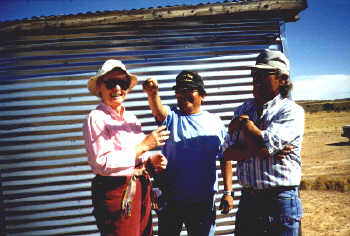
People are the real strength of the “hunger movement” and of WHES and HN. It has been a great pleasure for me, as it was for Pat, to know those involved with WHES, and many others involved with hunger issues and to work with them.
Archimedes said— give me a place to stand, and I will move the world. He was talking about the principle of leverage/mechanical advantage. With a long enough lever, a place to stand, and a place for the lever, Archimedes—light—could move something heavier— the world.
I would thus like to point out as a principal contribution of Pat through her twenty-plus years of service, that we— those who continue WHES and Hunger Notes— have a place to stand. It certainly remains to be seen, as WHES enters the fourth year since Pat’s retirement from WHES, how we can continue to develop and leverage our strength to make a significant contribution toward moving the world in the direction of justice and improved lives of poor people throughout the world. Nonetheless, it is certainly true, in Pat’s life of service to the disenfranchised of the world and to WHES, that she has left us a place to influence— change— the world and what happens in it.
WHES Thanks Annemarie and Wayne Mewhorter for Gift
Annemarie and Wayne Mewhorter bequeathed approximately $75,000 to World Hunger Education Service. Mrs. Mewhorter passed away in 2000, relinquishing the estate of her late husband. WHES gratefully acknowledges their bequest.
As directed in her will, we have established an endowment for WHES in the Mewhorters’ name. This will provide WHES with approximately $3,500 annually, which we will use for publication of Hunger Notes.
We did not know the Mewhorters. However, Mrs. Mewhorter’s will establishes a clear sense of their priorities, which focused on helping poor people and those disadvantaged in other ways. They made 22 distinct bequests including:
Poverty (Feed the Children, Bay County Women’s Center, Africare, Catholic Relief Services, Save the Children, Lutheran World Relief, the Albert Schweitzer Fellowship, and WHES)
Health and Disabilities (Leader Dogs for the Blind, American Lung Association, St. Jude Children’s Hospital, Make-A-Wish Foundation, International Red Cross, American Cancer Society, Christopher Reeve Paralysis Foundation, American Diabetes Association, Special Olympics of Michigan, National Kidney Foundation)
Other (Underground Railroad, Inc., Billy Graham Evangelistic Association, City of Frankenmuth Canine Unit)
Their concern for religion was evidenced by their bequests in Germany, which were all to German churches, as well as the contributions noted above to religious organizations devoted to helping the poor, sick and disadvantaged, such help being a fundamental command of Christianity.
WHES is proud to be remembered by the Mewhorters. It has been an unexpected recognition and affirmation of our goal, to help those in the United States (and now via the Internet, elsewhere) understand the desperate situation of poor people in the world, and how we in the United States might reach out to help them. May we be worthy of the Mewhorters’ trust, and, through our efforts and those of others who have received their bequest, may their goodwill and concern continue to act as a force for good in the world!
World Hunger Education Service Welcomes New Board Member David Langhaug and Thanks Departing Board Members Janna Marchione and Jennifer Munro for Their Service
(August 3, 2002) The World Hunger Education Service (WHES) is very pleased to welcome David Langhaug to its Board. He has had extensive experience in developing countries, in governance of organizations concerned with poor people, and in financial management. His career in the State Department spanned 25 years with service in Pakistan, India, Thailand, Ecuador and France. He has been a board member of the Transitional Housing Corporation since 1996, where he served as as Vice President, (1997-98) and Board President (1998-2000). He has also served as a board member of the Samaritan Ministry of Greater Washington from 1994 to 1998. Since 1991, Langhaug has been a financial advisor with American Express. He received a B.A. from Lawrence College and an M.A. in Political Science from the University of Michigan.
WHES would also like to thank two outgoing Board members, Janna Marchione and Jennifer Munro, for their services. In addition to participating in the essential Board duty of governance of WHES, Marichione played a key role in updating membership data and Munro helped greatly in the transition of Hunger Notes from a print to a web publication.
A Global Context for Hospitality
September 11, 2001 will be remembered in history as a day that changed the world. We are now living in a time of great danger, and equally great opportunity. The ways in which our world will be changed for better or for worse will be shaped by our actions. Above all, September 11 has underscored the interdependence of the United States with other nations, our global neighbors.
There can be no justification for the terrorist acts of that day in New York and Washington, D.C. Nor is there justification for continuing social and economic injustices that are inherently wrong and that provide a fertile breeding ground for terrorism. Our times require national answers to the ancient questions, “Who are our neighbors?” and, “What is our responsibility as neighbors?”
In small town United States the image of lending and borrowing between neighbors–a cup of sugar, vacation care for pets, errands–is commonplace. Few of us would deny hospitality to a neighbor we know.
In certain seasons–and in response to disasters of many kinds–our hospitality extends as charity to more distant neighbors whom we don’t know individually. At Christmastime every year newspapers carry heart-warming stories about local efforts to provide holiday meals to thousands of our less fortunate neighbors. During the holy month of Ramadan, Muslims provide the evening meal to all who would share the breaking of the fast, both rich and poor. This is similar to the Jewish tradition of sharing the Passover seder. When disaster strikes through floods, tropical storms or terrorist attack, the generosity of the American people is legendary.
Placing hospitality in a global context is a greater challenge. Geography and racial, cultural and religious differences make it difficult to recognize far away others as neighbors.
Although the United States has always been a multicultural society, the great diversity in the racial and ethnic backgrounds of today’s immigrants–together with the fact that many immigrants are from non-Western cultures about which many of us know very little–has contributed to an ebbing willingness to provide welcoming spaces and true hospitality for refugees and immigrants.
Stereotypes make it easy to ignore the richness of the cultural diversity and the different needs of each immigrant group. In addition, today’s immigrants face increasing hostility from citizens who believe that immigrants threaten their jobs and economic security. Such concerns become fertile ground for state and Federal-level legislation, denying even legal immigrants the rights guaranteed to native-born Americans.
Anti-immigrant fears are heightened by anxiety over the decline in our domestic manufacturing industry resulting in part from a great increase in low-cost imports from developing nations. Together, the influx of immigrants and imports are leading many to question the extent to which America’s borders should be open.
Christians, Jews and Muslims all share a common value base from which to begin addressing the issue of local and global neighborliness.
For Christians, in the parable of the Good Samaritan (1) Jesus asks which of three persons was neighbor to one who had been beaten and robbed and affirms the answer “The one who treated him with mercy.” Set in a multinational context, the parable implies that all human beings are neighbors.
In Judaism, giving to the poor is not viewed as a generous, magnanimous act, but as tzedakah, an act of justice and righteousness, the performance of a duty, giving the poor their due (2).
Giving alms to the poor is also one of the five pillars of Islam (3). Zakat (alms giving) means taking some of the wealth God has given and sharing it with the poor. The extension and acceptance of hospitality is sunnat (an obligation) for Muslims.
If we accept the poor and hungry of the world as neighbors and accept the teachings that we should love our neighbors as ourselves, we must extend hospitality–must transform social policy and in so doing become partners in transforming the world. As global citizens, we have responsibility to ensure that all people on this planet have access to the basic resources of food, clothing, health care, sanitation, clean water, shelter, education, love, and esteem that are necessary for a truly human existence.
Accepting this responsibility is daunting. However, it can no longer be avoided. Nearly 800 million people–one-sixth of the population of the world’s developing nations–are malnourished. In developing countries, 6 million children die needlessly each year, mostly from hunger-related causes. In these countries, one child in 10 dies before the age of five compared with one child in 165 in the United States. Each day 30,500 children die from preventable diseases including diarrhea, acute respiratory infections, and malaria. During the past 50 years, three times the total number of all people killed in all the wars of the 20th century died from hunger and poor sanitation. Today 880 million people lack access to adequate health services. The richest fifth of the world’s population consumes 86 percent of the earth’s goods and services, while the poorest fifth consumes 1 percent. Thirty-two percent of the population of developing countries exists on less than $1 per person per day. Two billion, six hundred million people lack access to basic sanitation.(4)
These are the conditions under which anti-Western terrorism flourishes. Transformation of these conditions is demanded by fundamental, shared values of Christians, Jews and Muslims and is necessary for success in the war that has been declared against terrorism. Success in that war requires addressing the social and economic conditions under which terrorism flourishes. The aphorism, “To achieve peace, work for justice” has never been more necessary than it is today. Indeed, there is no feasible alternative within a democratic context in which cherished freedoms are preserved.
Addressing the social and economic needs of humankind is essential to a successful war against terrorism. While military interventions may succeed in routing one or many terrorist networks, as long as the conditions that breed terrorists persist, new generations of terrorists will emerge.
The educational activities of Bread for the World, Church World Service, Network, and other religious organizations are beginning to win the hearts and minds of civil society in the United States. A national public opinion poll released February 1st shows that a large majority of Americans strongly support both foreign aid and efforts to reduce world hunger.
The poll was funded by the Rockefeller Foundation, and conducted by the University of Maryland’s Program on International Policy Attitudes. Eighty-three percent of those polled said that the United States should join an international effort to cut world hunger in half by the year 2015; 87 percent favored giving food and medical assistance to countries in need; and 75 percent said they would be willing to pay an additional $50 a year in taxes to cut world hunger in half.
Most people polled vastly overestimated the amount we spend on foreign aid. When asked how much of the U.S. budget goes to foreign aid, the median estimate was 20 percent, more than 20 times the actual amount we spend today. When asked how much should go to foreign aid, the median response was 10 percent, more that 10 times the actual amount. Asked about spending 1 percent, only 12 percent of Americans polled thought that it was too much.
Foreign aid makes up less than 1 percent of the U.S. budget. Less than 1/10 of one percent is spent on economic aid.
It is important to keep in mind that the burden of ending hunger and the other plagues of poverty and injustice is not ours alone to bear. Extending hospitality and neighborliness involves reciprocity and shared struggles. In recent years I have traveled to Mexico and India, to South Africa and Uganda. In multiple communities in each nation I met with groups of extraordinary, intelligent “ordinary people,” each one dedicated to partnering with their neighbors at home and abroad to improve their circumstances and the prospects for the children and grandchildren of their communities. As we seek effective ways to share in these struggles, we join millions of our neighbors throughout the world. With them we are partners in the most basic form of hospitality, the process of ending hunger at home, everywhere.
A long history of global challenges and unmet needs has become more urgently important in light of the attacks of September 11. There are several initiatives the United States can pursue to respond positively to the opportunities and challenges of today’s world.
First, we need to operate in concert with the international community to enhance human rights. Our propensity to “go it alone” has resulted in a systematic refusal to sign international accords that have received nearly universal backing from other nations. The United States should sign, ratify, and actively support the United Nations Covenant on Economic, Social and Cultural Rights, the Convention on the Elimination of All Forms of Discrimination Against Women, the Convention on the Rights of the Child, the Comprehensive Nuclear Test Ban Treaty, and the conventions and protocols banning chemical and biological weapons and anti-personnel land mines.
Second, we should redouble our efforts to find just solutions to the protracted conflicts in Northern Ireland and, especially, in the Middle East. We need to apply equal standards of conduct to all parties to these conflicts.
Third, the United States should provide leadership by taking a step as bold as that of the post-World War II Marshall Plan. Working through the United Nations, in partnership with the industrialized nations of the global North and with the non-governmental organizations of civil society throughout the world, we must commit to economic development at the grassroots level, resources of the magnitude that we are prepared to commit to waging war. Congress recently appropriated $40 billion for the war against terrorism. The United Nations Development Program estimates that an additional $13 billion per year would meet the basic health and nutrition needs of the world’s poorest people. If the U.S.-led coalition is serious about ending terrorism, these additional resources must be provided.
Surely, this is a feasible way to begin to set the table for global hospitality.
William H. Simpson Whitaker is Professor and Dean of the Marywood University School of Social Work in Scranton, Pennsylvania. An earlier version of this article appeared in the Winter 2002 issue of Journey, a publication of the Sisters, Servants of the Immaculate Heart of Mary. If you have a comment on this editorial which you would like to direct to the author, he may be contacted at whitaker@es.marywood.edu
Footnotes:
1. New American Bible, Luke 10:36-37.
2. For example, see Leviticus 19:18 “Take no revenge and cherish no grudge against your fellow countrymen. You shall love your neighbor as yourself,” and 19:33 “When an alien resides with you in your land, do not molest him.” In his final words to the people of Israel (Deuteronomy 27:19), Moses says, “Cursed be he who violates the rights of the alien, the orphan or the widow.”
3. “And in their wealth there is acknowledged right for the needy and destitute.” Qur’an 51:19
4. Source: Bread for the World hunger basics: International facts on hunger and poverty. (2001)www.bread.org/hungerbasics/international.html.
HBO documentary about Sergio Viera de Mello airs May 2010, beginning May 6
September 7, 2012
This month, beginning May 6, HBO television will premiere its riveting documentary “Sergio” based on the book “Chasing the Flame” by Samantha Power about the Brazilian diplomat Sergio Vieira de Mello. The film includes notable interviews from refugee and aid experts, and surveys Sergio’s life in brief. Giving short shrift to much of his United Nations work at UNHCR, and does not discuss OCHA, it primarily conveys the message that he was one of the first in to Cambodia in the late 1980s to negotiate with the Khmer Rouge, and then was a participatory and sympathetic leader of East Timor after its independence and UN trusteeship.
Over half of the screen-time is devoted to the circumstances of Sergio’s death in Iraq. Film viewers learn more about searching through collapsed buildings than about the U.N., but it’s a story well-told with gripping personalities and a firm narrative arc.
Greg Barker, the film’s director, took the decision to anchor the story around the compelling search-and-rescue operation by two humble and heroic US army medics: Andre Valentine and William von Zehle, who struggled to find and extract Sergio after he was buried in the United Nations compound that was bombed on August 19, 2003. These two U.S. soldiers, neither of whom knew Sergio, share the frustration of finding him alive at the bottom of a shaft. They succeed in rescuing refugee-scholar Gil Loescher who was buried with Sergio. But no heavy equipment was available to dig for Sergio during the 3 hours that he held on from massive internal bleeding.
After a long and distinguished career primarily in humanitarian aid, Sergio had been appointed in 2003 by Kofi Annan to head up the new U.N. operation in Iraq. Sergio did not wish to stay long in the position and sought to return to his more permanent global U.N. assignment as the High Commissioner for Human Rights which would have positioned him to be a future Secretary General. The most powerful moment in the film was prior to the bomb attack when Sergio forcefully explained at a press conference in the same building that would bury him that he and his office were independent and not a tool of the U.S. Government, a message that may well have convinced would-be bombers from choosing a different target than the U.N., had they heard it. The documentary did not take sides about the war in Iraq, nor refer to casualties of Iraqi civilians or those in any of the other crises touched by Sergio. Nor did it mention refugee expert Arthur Helton, who was also killed in the same bombing.
Much of the strength of the documentary derives from the original interviews with individuals who worked with Sergio, such as Dennis McNamara, who led UNHCR’s protection work for a long time. Somewhat ironically, it features Richard Holbrooke who takes credit for Sergio’s selection to head the UN operation in East Timor, ironic perhaps since Holbrooke has been criticized in his role as Assistant Secretary of State for East Asia for allowing U.S. weapons to continue to flow to Indonesia in 1977, after Indonesia’s 1975 invasion of East Timor, which it would occupy until 1999.
In an advance showing at the U.S. State Department in April 2010, attended by numerous U.S. refugee officials who knew Sergio, as well as Samantha Power, it was noted that he specialized in listening to all persons and sides, even within the United Nations High Commissioner for Refugees, making him the rare individual in a bureaucracy who was liked by everyone. Barker also made the excellent documentary about the Rwandan genocide, “Ghosts of Rwanda”, which is useful for classroom teaching and discussion. “Sergio” teaches little about the United Nations, or complex emergencies, or aid operations and is less useful to learn from. The key message of Sergio’s career, the film advances, is the value of being willing to talk with combatants, rebels and even those guilty of war crimes.
Steven Hansch is a member of the board of the World Hunger Education Service, serves on several other non-profit boards, teaches about humanitarian aid at several universities, and has worked overseas conducting nutrition and public health programs, primarily in emergencies.
A Crisis of Legitimacy and Effectiveness Requires Making International Institutions More Democratic
Although globalization has vastly expanded the demands on global institutions, it has also heightened a crisis of legitimacy and effectiveness. Large parts of the public no longer believe that their interests are represented in institutions such as the International Monetary Fund, World Bank, UN Security Council and the World Trade Organization or that the institutions are adequately accountable for what they do. Representation and accountability have always been weak in these multilateral institutions. But today the weaknesses are glaring because the institutions are being called on by their powerful members to intrude much more deeply into areas previously the preserve of national governments especially in developing countries. Over the past two decades these institutions have increasingly prescribed and required structural and institutional reforms. For example, in the 1980s countries that borrowed from the IMF and World Bank were required to meet 6-10 performance criteria and in the 1990s, some 26.
Efforts to deepen democracy in international institutions must confront the realities of global power. Powerful countries will inevitably invest more energy and political capital in institutions that enable their power to be exercised. Once they are members of an elite club, countries are reluctant to lose that power or see it diluted by opening to new members. This explains why proposals for reform always encounter stiff resistance. And that is why broad acceptance of the principle of democratization has translated into so little progress at the level of specific proposals.
Although developing countries are deeply affected by the decisions of institutions such as the IMF, World Bank and WTO, they have little power in their decision-making. There is an unavoidable democratic deficit in international organizations because people do not get to directly elect (or throw out) their representatives. This would be true even if all member countries of international organizations were flourishing democracies. […] That said, however, the democratic deficit does not rule out improving the representativity of international organizations.
The role of developing country governments in global governance needs to be bolstered through changes in formal representation. This is a necessary (albeit insufficient) condition to redress the existing bias in international organizations. […]
What is needed is to rewrite the way seats and votes are allocated within international organizations, to better recognize the increased stake of developing countries. Their cooperation and commitment to international agreements is vital if any international organization is to succeed in managing globalization.
For this reason the old rules about representation are no longer viable or desirable. Put bluntly, the IMF and World Bank will not be able to do their jobs effectively if they remain tied to structures that reflect the balance of power at the end of the Second World War. In the past 55 years their roles and duties have changed beyond recognition, as have the expectations of their vastly increased membership.
Nearly half of the voting power in the World Bank and IMF rests in the hands of seven countries (the U.S., Japan, France, U.K., Saudi Arabia, Germany, and the Russian Federation). This voting power is exercised in the formal decision-making bodies – the executive boards – of each institution.
Equally important are the informal influences and traditions that shape the work of these organizations. These informal processes further weight the scales in favor of industrial countries. For example, the heads of the World Bank and IMF are chosen according to a political convention whereby the United States and Europe nominate their candidate for each, respectively. Other countries and critics rightly brand the process as undemocratic and insufficiently accountable.
Yet more profoundly, the institutions are often criticized by academics, industrial country NGOs and developing country analysts for basing their economic advice and policy conditionality on a narrow worldview that reflects the interests of their most powerful members. In particular, they are widely perceived as being overly accountable to their largest shareholder, largely through informal influences such as the location and staffing of the organizations and their susceptibility to pressure on select issues.
These concerns about who the IMF and World Bank represent have been heightened as the institutions have begun to prescribe policies over an ever broader range of issues. […] The new role of the IMF and World Bank highlights the need for deeper participation by their borrowers: developing countries.
A primary source of contention relates to the shares of developing and industrial countries in decision-making. Members of the IMF do not have equal voting power. Voting weights are based on two components. Each member has a set of 250 basic votes that come with membership. The second component is determined by economic power. Votes accompany country quotas that reflect the economic strength of countries. Since the formation of the IMF there has been a major imbalance in the evolution of the two sources of voting power.
Basic votes have declined dramatically as quotas have increased. The share of basic votes in voting power has declined from 12.4 % to 2.1%. At the same time, an additional 135 countries have become members, including many transition economies.
During this period the basic nature of the IMF and World Bank has changed. They were created at the end of the Second World War as institutions of mutual assistance. The IMF would provide resources to any country facing temporary balance of payments difficulties. The World Bank would help channel investment to countries for postwar reconstruction and development. This sense of mutual assistance has changed in the intervening years.
Today the IMF and World Bank lend exclusively to developing and emerging economies. Furthermore, their loans are linked to conditions that increasingly impinge on the domestic policies of the state. The result is a new kind of division between creditor countries on one hand, who enjoy increased decision-making power and have used it to expand conditionality, and borrowing countries on the other, who view conditionality as externally imposed. This can be particularly worrisome when there is considerable division of opinion on that policy advice, and when the risks associated with the policy advice are borne almost exclusively by the people of the borrowing country. […]
There is now greater recognition of the need for the World Bank and the IMF to increase the representation of developing countries. They could do so in a number of ways.
First, by increasing the proportion of basic votes allocated to each member.[…] Second, by enhancing the voice of developing countries within the institutions. Formally, all members of the IMF and World Bank executive boards are supposed to appoint the institutions presidents. But by convention, Europeans select a candidate for director of IMF and the U. S. government selects the head of the World Bank.[…] A selection committee for such a post would enable broader participation and transparency.
Another step would be increasing the number of seats for developing countries on the executive boards. At present executive directors from developing countries represent large constituencies and have minimal input on policy formation. […] Third, by making the institutions more accountable for their actions, not just to their board members but also to the people affected by their decisions. Governments are held accountable through a variety of social, political and legal institutions. These institutions must also be used to make global financial institutions more accountable. Specifically, this means ensuring transparency and monitoring and evaluating their rules, decisions, policies and actions. […]
To be effective, the results of all of these evaluations must be published, followed up and investigated, and necessary changes undertaken. This is particularly important for large organizations suffering from considerable inertia.
Without publication of independent assessments of what organizations are doing, it is not only difficult for the public to judge how well or poorly an organization is undertaking its responsibilities, it is also impossible for outsiders to offer support to insiders who recognize the need for change. By publishing critical reports, institutions can catalyze public attention and external pressure for change, helping to overcome inertia or vested interests within the organization. […]
The United Nations Development Program is the UN’s global development network, advocating for change and connecting countries to knowledge, experience and resources to help people build a better life. The Human Development Report is UNDP’s report on development issues. This year’s report, the Human Development Report 2002, focuses on “Deepening Democracy in a Divided World.” Ch. 5, from which this excerpt was taken, is entitled “Deepening Democracy at the Global Level.”
Treasury Secretary O’Neill is Half Right: Make Grants Not Loans to the Poorest Countries (But First Increase Development Assistance)
Treasury Secretary Paul O’Neill has suggested that the World Bank should begin making grants instead of loans to the poorest developing countries. He is upset that the Bank, as well other developed countries, who have seats on the Bank governing board, don’t want to go along with this proposal. (See related story.)
Secretary O’Neill is half right. He is correct in asserting that the World Bank should begin making a substantial portion of its new commitments as grants, not loans. For various reasons, the poorest countries are not able to pay back loans that the World Bank and other lenders have been making. Where he is wrong is in not recognizing the valid opposition to his position, a key reason being that that resources provided to developing countries by developed countries, including those provided by the Bank, are very scarce, and valid methods of economizing on those resources, such as making loans, not grants, are in order. What he evidently does not realize, or possibly for political reasons chooses to ignore, is that the United States has led the “race to the bottom” in not providing resources to poor countries, and that this lack of resources is a major reason why other developed countries favor grants.
The two are intertwined.
Why the World Bank should begin making grants not loans.
It will be useful if the reader has a basic understanding of a Bank loan to the poorest countries, which are made by a Bank “lending arm” called the International Development Association (IDA). An IDA loan is on very generous terms–for 40 years and for something like a 3 percent interest rate. (Would that we could finance our houses on such good terms!) The point is that there is a significant subsidy component of IDA loans–at least fifty percent and probably up to 80 percent. (To compare with U.S. mortgage loans, the interest rate on U.S. mortgage loans is certainly more than 6 percent, which would indicate that IDA loans at 3 percent, have at least a 50 percent subsidy component.) So on one important level, IDA loans are a “good deal.”
The second thing to understand is how this lending plays itself out over time–the 40 year time period of the loan. There are three things to consider: the flow of financial resources, the productivity of the loan, and the country and international circumstances surrounding the loan.
Suppose that each year for forty years a loan is made. (World Bank lending to developing countries began in earnest in the 1960s, so we are at the end of this 40 year repayment period for the first loans to many developing countries.) In the first year, the loan is made, suppose for $10 million, and suppose this amount to continue each year. The country receives all the benefits from this loan. In the second year another loan is made for 10 million. However 2.5 percent or (100 percent divided by 40 years) must be repaid. Thus the net benefit in terms of incoming resources is $9,750,000. In the 21st year the new loan is $10 million but the net benefit is only $5 million. In the 40th year the new loan is $10 million, but the loans of 39 previous years must be repaid, leaving a net gain to the country of only $250,000. In subsequent years, there is no net gain. This is how a debt crisis arrives. What looks like a good deal, and certainly is in the beginning, becomes much less so.
We can then see a very important difference between grants and loans. Over a period of time, loans, which must be repaid, will have a greater fluctuation in net benefit, with a large net benefit at the beginning and and a very small one as the number of years in which loans have been made approach the repayment period for the loans. On the other hand, a grant, identical in size each year, will deliver the same benefit each year.
A significant portion of IDA loans are for primary health and primary education. That the developed countries (through the World Bank) should support primary health and education is extremely worthwhile. Done well, it is a contribution to the poorest people in these countries, one which will enable them to lead healthier, more knowledgeable, and more productive lives. Where then are the difficulties? We would point to three areas. First, the loan may not be well used. Secondly, the political and economic circumstances in the country may reduce the benefits of the loan. To understand the third difficulty, we must remember that an IDA loan is paid to the country in dollars (which can then be used for purchasing imports for the country) , and must be repaid in dollars. This requirement essentially requires that the activity for which the economy must generate enough foreign exchange–dollars or Euros. Thus even though the loan was used for highly productive purposes, there may be difficulties in generating the foreign exchange/U.S. dollars to repay the loan.
To review this again, with examples.
First, the loan may not be well used.. The loan would typically be paid to the finance ministry of the country. All of the loan might not reach the health ministry. Alternatively, the loan could be used to finance efforts of a dysfunctional national health ministry. Though improvements were planned for and expected, they might not occur.
Secondly, the political and economic circumstances in the country may reduce the benefits of the loan. The country might be at war, or in a state of high unemployment/a low level of economic activity. Being at war would certainly increase the costs of educating children in war zones, and very possibly make it impossible. Conflict in a nation typically reduces the economy to a shambles. With high unemployment/low level economic activity, the hoped for economic benefits of educating people with the result that they would be better workers would not be as significant. People must be employed before education can be translated into higher productivity.
Finally, surprising as it may seem, the loan could be used for very productive purposes, the overall political and economic situation could be quite favorable, and yet, the loan, or the economy, might not generate sufficient foreign exchange to repay the loan. Suppose the loan is used to educate children and do it successfully. How will this generate enough foreign exchange to repay the loan? Repaying the loan requires a successful export sector. A successful export sector is not automatically created by educating children.
In conclusion, what should be done? In the ideal world, developed country assistance would be adequate in amount and provided as grants. In the real world, there is a minimal amount of development assistance, and there is pressure to economize. This is done by requiring the governments of the lowest income developing countries to repay their loans, which substantially reduces the benefits to the poorest countries and the people living there. Development assistance should be increased, and–not small steps!–every effort made to ensure that the loan will be well used and that the country political and economic circumstances will be favorable for productive use of the loan.
If we want food to remain cheap we need to stop putting it in our cars
Coverage of the US drought and the run-up in corn, soybean, and wheat prices has been extensive and welcome. It has also been prone to the repetition of falsehoods and the perpetuation of myths about the causes of the food crisis – and the solutions.
