



On Monday and Tuesday Mother Jones published exclusive video that captured Mitt Romney speaking to donors at a May 17 fundraiser, which was held at the home of private equity mogul Mark Leder. Responding to a question about the “Palestinian problem,” Romney said peace in the Middle East is not possible and a Palestinian state is not feasible, telling donors that Palestinians have “no interest whatsoever in establishing peace and that the pathway to peace is almost unthinkable to accomplish.” At another point, the GOP presidential nominee told attendees of this $50,000-a-plate dinner that 47 percent of Americans—those who back President Obama—are “victims” who are “dependent upon government” and “pay no income tax.” He noted: “My job is not to worry about those people. I’ll never convince them they should take personal responsibility and care for their lives.”
Author: WHES
Coal lease scandal poses a riddle: will India ever be able to tackle corruption?
NEW DELHI — His business rivals never fully understood how Manoj Jayaswal got so rich so fast, except that he often seemed joined at the hip with powerful politicians. He hosted them at lavish parties, entertained them at his daughter’s opulent Thai wedding and stood among them at India’s presidential palace, where a year ago he was praised as a leader in the India growth story.
How corruption affects the poor children of India

MEENA DEVI is only 10 years old, but she’s the head of her household. She cooks, cleans and takes care of her 11-year-old brother, Sunil, while a 14-year-old brother, Anil, works at a faraway brick kiln in a neighboring state. The three have been orphans since their mother died of starvation three years ago. They have an aunt in their village, but the most she’s ever done is send over food to their mud hut.
Fed ties new aid to jobs recovery in forceful move
WASHINGTON — The Federal Reserve opened a new chapter Thursday in its efforts to stimulate the economy, saying that it intends to buy large quantities of mortgage bonds, and potentially other assets, until the job market improves substantially.
USAID nutritionist leaves legacy of saving lives
(September 1, 2012) Frances Davidson recently retired from the United States Agency for International Development (USAID) after dedicating 24 years to efforts for improving the nutritional well-being of people in developing nations. She served as acting Director of USAID Office of Nutrition and Director of nutrition programming at USAID during that time. Hunger Notes took the occasion of her retirement for an interview, to gain a perspective on USAID’s important work on nutrition during those years.
 Frances Davidson
After completing a doctorate at the London School of Hygiene and Tropical Medicine Davidson came to Washington, DC, with her husband, who took a post at the British Embassy. She was hired in 1987 to work in the US Agency for International Development’s Office of Nutrition and soon afterwards rose to directing the office. She oversaw the merger of the Office of Nutrition into the larger Office of Health and Nutrition (later the Office of Health Infectious Disease and Nutrition-HIDN) within USAID where she continued to focus on issues of malnutrition in low income countries.
During her tenure at USAID, she grew the Agency’s nutrition program by establishing relationships with related sectors such as reproductive health, education, infectious diseases, agriculture, and gender.
As an anthropologist/nutritionist, she recognized the need to consider socioeconomic and cultural factors related to the prevention of malnutrition in differing contexts. Her view is that child malnutrition is a symbol of a systems failure within a country and only by focusing on all parts of the system, e.g., food production, distribution, health care and the policy framework could long term prevention and control of malnutrition in all its forms be prevented.
Given the modest resources of the nutrition program, she worked with colleagues to catalog the reasons for malnutrition in a particular country and then identified the aspects that were appropriate for USAID investments. To this end, she built upon previous work and continued the funding of research and analysis, both scientific and programmatic in developing countries through agreements with universities, governments, non-governmental organizations, foundations and private enterprise organizations.
One of her major accomplishments was to continue supporting vitamin A research and propelling forward vitamin A policies and intervention campaigns to address this debilitating deficiency. Part of that initiative was to support Dr. Alfred Sommers’ groundbreaking research on vitamin A’s relation to young childhood morbidity and mortality. (Sommers’ research on vitamin A in the 1970s and 1980s discovered that dosing severely vitamin A deficient children with an inexpensive, large dose vitamin A capsule twice a year reduces child mortality by as much as one-third. The World Bank and the Copenhagen Consensus record vitamin A supplementation as one of the most cost-effective health interventions in the world).
The USAID Office of Nutrition drove the vitamin A research through grants to non-governmental agencies such as Helen Keller International (HKI) to conduct some of the piloting field work. Monies and mentoring opportunities were made available to young researchers, especially women, in developing countries through NGOs such as International Center on Research for Women (ICRW). Davidson recognized that Vitamin A deficiency and programs to overcome it were more easily understood than the complex of malnutrition factors. By helping countries accomplish vitamin A deficiency prevention programs, USAID gained the confidence of colleagues and could expand programs to include other nutritional deficiencies.
Congressional support for efforts to increase child survival and prevent childhood malnutrition allowed Davidson’s office to expand the original idea of blindness prevention through vitamin A distribution to one that included treatment, rehabilitation and skill development to enable individuals with varying types of sight impairment to lead productive and meaningful lives. USAID worked closely with the Perkins Institute on blindness prevention as well as the SEVA Foundation HKI, the International Eye Foundation(IEF) and others to achieve this. In order to maximize impact, USAID sought out innovative ideas to reach those in need and beyond the range of most programs. In order to help accomplish this, the Office of Nutrition worked on developing private and public partnerships, such as with Hoffman La Roche/Sight and Life Foundation and BASF Global (Badische Anilin und Soda Fabrik) to supply vitamin A capsules and conduct research. For instance, Hoffman La Roche supported “Sight and Life” to promote young investigators’ work.
In recognizing the need to document the impact of USAID programs and track program progress in collaboration with host country colleagues, nutritional surveillance efforts were supported. She considers it an accomplishment that USAID supported countries incorporated indicators of nutritional status into their ongoing health indicators reports. Along with USAID Mission colleagues, she worked to get nutrition mainstreamed with other important health interventions such as tuberculosis and HIV/AIDs, food fortification with key micronutrients (vitamin A, iron, iodine)—vital nutrients often missing in people’s diets in developing nations. A focus on diet quality and micronutrient nutrition became a strong component in USAID mission policies and programs especially where there was high young child mortality (under five- year-olds) signaling micronutrient deficiencies – the silent cause of death of young children.
Additionally, she and her office developed and fostered private sector partnerships to promote food fortification with micronutrients and other important nutrients in a number of countries. The Division of Nutrition joined with the Gates Foundation and others to help start GAIN, the Global Alliance for Improved Nutrition, with the focus on expanding the application of food technologies to improve nutritional quality of foods in as many low income countries as possible.
Translation of science and technology into programs that were appropriate to low income countries and that improved lives was central to her work.
Political will is a universal aspect of successful programs. She noted the critical importance of having devoted congressional support for USAID’s efforts. Political leaders such as George McGovern, Tony Hall and Mickey Leland, and key staffers such as Tim Rieser were essential, as was the Select Committee on Hunger which raised the visibility of the problem and encouraged cooperative and innovative solutions. The existence of an office or committee on Capitol Hill with a mission to improve food security and nutrition to push forward the knowledge base and programs to combat malnutrition was important to the success of USAID supported programs.
Recognizing the fact that if a population was deficient in one critical nutrient, such as vitamin A, there was a good chance they were deficient in others, Davidson expanded the program and policy portfolio to include a range of vital nutrients, in particular iron deficiency anemia which has compromised the well being of countless women and children. In order to help countries document the extent of the deficiency, USAID supported the development of the hemocue, a simplified field tool that could be used by minimally trained field workers to assess iron deficiency. DHS began using it in select country assessments.
In addition to documenting the extent of anemia in populations, Davidson and her office worked hard to get important nutrition indicators such as dietary diversity to better understand nutritional deficiencies and their health outcomes included in Demographic and Health Surveys (DHS), health surveys conducted in many different developing countries over a many years which have been crucial in demonstrating progress, or the lack of it, in key measures of health. There were many obstacles and challenges to having these questions integrated into the DHS; however, it was important information to enable ministries and governments to weigh and consider the ramifications of nutritional deficiencies and what they meant in terms of development for their country’s populations. Likewise, it was important for those funding nutrition programs to gain an understanding of the impact of nutritional on national security, political stability and overall development issues. One core factor in USAID’s nutrition work has always been the close collaboration with other agencies, and host country colleagues in order to ensure suitability of programs. Policy impact and sustainable improvements in the health and well being of the most disadvantaged.
The efforts of Davidson and her colleagues at USAID have advanced overall knowledge of micronutrient deficiencies, their role in health and wellbeing and policies and programmatic practices to treat nutritional problems in order to promote the development of individuals and their communities.
Thank you, Dr. Frances Davidson!
Ferris-Morris is a nutrition consultant and a board member of the World Hunger Education Service, the publisher of Hunger Notes. This article is based on a July 2012 interview with Dr. Davidson.
Income gap between the wealthiest 20 percent of American households and the rest of the country grew sharply in 2011, Census Bureau reports
WASHINGTON — The income gap between the wealthiest 20 percent of American households and the rest of the country grew sharply in 2011, the Census Bureau reported, as an overwhelming majority of Americans saw no gains from a weak economic recovery in its second full year.
Obama, Romney answer faith leaders’ call to address poverty in election (video)
Christian leaders asked, and the presidential nominees answered. The poverty rate in America is still at a staggering 15 percent and 46.2 million Americans remain in poverty — what is your plan to address the problem? –
Outlook grim for middle income workers, report says
Middle-income workers have endured a “lost decade” of stagnant wages and are teetering on the brink of another, the consequence of both the recent recession and a long series of policy choices that have eroded their leverage in the job market, according to a report.
New Initiatives in Development Education
Most Americans support U.S. involvement overseas for humanitarian, environmental and other social causes, according to public opinion polls. Many support or work on refugee resettlement, peacemaking, and cultural exchange program through churches, civic groups, and universities. Yet they are not organized to influence policymakers, who generally believe that the U.S. public cares little about the rest of the world.
To narrow the gap between citizen concerns and policymaker perceptions, three initiatives have been founded recently. The Global Interdependence Initiative (GII) is a collaborative effort of the Aspen Institute, the Benton Foundation, and the Rockefeller Brothers Fund. The Better World Campaign (BWC) is a project of the United Nations Foundation founded with a $1 billion donation from media mogul Ted Turner. Global Connections (GC) is a project of InterAction, an umbrella association of U.S.-based nonprofit groups that carry on humanitarian work overseas.
Most Americans believe the US devotes far more to foreign aid than the actual figure.
The primary purpose of all three initiatives is to educate and mobilize constituencies to redirect and improve U.S. global engagement. The BWC is focused on the specific goal of getting the U.S. to pay more than $1 billion in back dues to the UN, while the other two have a related, broader purpose: bringing about a U.S. foreign policy that is more consistent with deeply held American values, such as compassion, hope, justice, and peace.
BWC and GC are relatively short-term efforts, designed to meet their goals in two or three years, while GII will operate over a decade– from 1998 to 2008. Directors of the three groups keep each other appraised of their activities and anticipate no problems with duplication or overlap.
Two of the three initiatives can rely on networks throughout the country, which will facilitate their campaigns at the grassroots level. InterAction, the home of GC, has 160 affiliated nonprofit members with millions of supporters nationwide. BWC draws on a network of 200 UN Association (UNA) chapters across the country with more than 22,000 individual members who support the UN. The third initiative, GII, has an advisory group of nongovernmental organizations (NGOs), including groups such as CARE and the Sierra Club.
All three initiatives seek to educate and mobilize policymakers and the media, as well as the public, to correct misinformation about global engagement and raise its priority in American society. These three actors—the public, the policymakers, and the media—form an opinion loop on which each influences and reinforces the attitudes and behavior of the others, according to GII. The public, perceived as indifferent or even hostile to foreign affairs, has these attitudes reinforced by policymakers who denigrate foreign aid and by the media that present few news stories on international issues.
The three initiatives also have in common the goal of embracing a variety of viewpoints. BWC is creating partnerships with diverse groups ranging from the Rotary, which is active in small towns and has a long history of involvement and support of the UN, to faith-based communities such as United Methodist Women. Global Connections, too, has targeted diverse constituencies ranging from refugees concerned about the countries from which they emigrated to young professionals idealistic about the potential for world change.
GII will encourage diverse viewpoints on topical interests by giving priority to interdisciplinary activities, according to its coordinator, David Devlin-Foltz. For example, a human rights group and an environmental group might cooperate on a project to promote environmental justice, or organized labor and business interests might collaborate around the establishment of minimum working standards,” he said.
“We can’t see a problem whole unless we get a variety of perspectives– the human rights activists, the environmentalists, the development experts. No one group has a comprehensive view,” he added.
The public consistently overestimates the amount the US spends on foreign assistance by a factor of 10 to 20.
A determination to narrow the gap between Americans’ views on what U.S. foreign involvement should be and actual U.S. policy overseas is another strong drive common to the three initiatives. During separate interviews in May, the director of each initiative expressed concern about this discrepancy. Each referred to the “one percent gap” revealed in a study entitled Americans and Foreign Aid which found that most Americans believe the U.S. devotes far more to foreign aid than the actual figure, which is under one percent of the budget.” The public consistently overestimates the amount the U.S. spends on foreign assistance by a factor of 10 to 20, according to GC.
The public looks to policymakers to lead on foreign policy but today’s public officials are less concerned and less informed on global issues than at any time in the last 20 years, according to GC. Most politicians feel no pressure to lead on foreign policy because there are so few organized constituencies advocating the action. Because the public has few sources of information on global issues, the media play a central role in shaping public discourse. They focus on the sensational– natural disasters, famine, and “ethnic cleansing”– and omit countervailing success stories. With appropriate guidance, however, policymakers and the media may be able to stimulate new interest in foreign affairs and eventually influence a more balanced foreign policy that better reflects the interests of the American public.
Formation of the initiatives was prompted by national trends including a sense of the vacuum in foreign policy since the Cold War ended. The Cold War at least delineated U.S. allies and enemies. “There was a perverse security in the simple perception that we inhabited a bipolar world. It is unsettling for us all to have a sense that we don’t know how to control foreign policy any more,” said Devlin-Foltz.
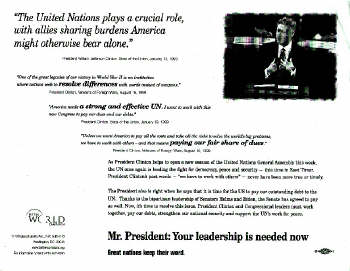
The trends that produced these three projects have more ominous implications, however, according to J. Brian Atwood, departing administrator of the U.S. Agency for International Development. In a farewell speech to the Overseas Development Council on June 29, he noted that the politics of the budget process is producing “backdoor isolationism” in the United States. The budget surplus of more than $1 trillion over the next 15 years is more than the combined GNPs of South Asia and sub-Saharan Africa, he said. “Yet we continue to run our government under budget caps set when we had a deficit.”
“Despite our prosperity today,” he warned, “we are in a negative spiral. We are already fast approaching a world where 10 percent of the people control 90 percent of the wealth. We hear rhetoric about a more equitable world where America’s vision of a democratic, market-based globe can be realized, but it is not matched by resource allocation. Our own political system and our press seem to miss this credibility gap, but the developing world does not.”
GII: Framing a New Foreign Policy
The first priority of the institutions and senior NGO representatives who have collaborated to found the Global Interdependence Initiative is to create a new foreign policy framework expressed in compelling, metaphorical language that makes global issues more salient to Americans.
Opinion polls indicate that Americans’ attitudes are based on a framework of underlying interests such as livelihood, security, and community, and values such as fairness and justice. These interests and values have implications for how the United States should conduct itself in an age of globalization. “We need to discern the message behind what people are saying. We’ll then be able to recast the issues in terms that people are using in daily discourse,” said Devlin-Foltz. GII labels this process ‘framing foreign policy.’
The Benton Foundation, one of the founding institutions, will lead the GII effort to collaborate with public opinion experts, linguists, psychologists and media scholars to find the most effective metaphors, the best comparisons, the most persuasive voices to use with various audiences to promote cooperative international engagement.
Benton has worked for five years to document dominant media frames and to devise new ones through focus groups. Under Benton’s leadership, GII will continue that work, reviewing research to see how the public interprets global issues, commissioning papers on the world views associated with desirable policy outcomes, testing model frames through focus groups and surveys, and creating a strategy for communicating global engagement.
“We intend to work with the media to help them see the marketability of a different approach, rather than to tell them that what they’re doing is wrong,” Devlin-Foltz said. “The media recognize that they need to improve their coverage. The American Society of Newspaper Editors, for example, is saying that newspapers are doing too narrow a job [covering foreign affairs]. Foreign correspondents are frustrated by their shrinking news hole.” Devlin-Foltz acknowledged that the goal of guiding the media to a different approach is “extraordinarily ambitious.”
According to Devlin-Foltz, “GII is not trying to create new knowledge or new values, because the knowledge and values are there. We are trying to raise the salience of values already dear to Americans,” he said.
“There may be broad public support for the UN, for example, but it is not raised to the level of a voting issue. To the extent that the UN is a voting issue, it’s the anti-UN, anti-development zealots who have had influence. Elected officials respond to zeal and passion, to what they hear at the town meeting back home and on their answering machine. And they assume that those views represent a sizeable ground swell. When they’re given no evidence to the contrary, that’s what they remember when they vote.”
An example of an overarching framework for cooperative global engagement might be “making globalization work for everyone.” This frame could evoke the notion of a shared enterprise whose partners must treat each other with respect and reciprocity.
“The US is in a desperate situation–approaching a time when we could lose our vote in the General Assembly.”
The Aspen Institute will house a small secretariat; the Rockefeller Brothers Fund (RBF) will provide leadership; and the Benton Foundation will lead development of a new foreign policy framework and help design public education programs. RBF and an anonymous donor provided the initial funding. Two-thirds of the approximately $3 million for the first two years of the decade-long campaign is already in hand or firmly pledged, according to Devlin-Foltz.
By the end of 10 years, GII hopes that Americans will be able to recognize how international policies and behaviors reflect or fail to reflect their interests and values. They anticipate that existing constituencies will have expanded and new ones formed that can mobilize quickly to advocate policies that promote global interdependence. A final goal is that U.S. policy direction more strongly favor cooperative, inclusive, and broadly conceived approaches to global problem solving.
BWC: Saving the U.S. Seat in the General Assembly
BWC is a two-year project with an urgent mission. “The U.S. .is in a desperate situation—approaching a time when we could lose our vote in the General Assembly,” said Phyllis Cuttino, director of BWC, a project of the UN Foundation’s Better World Fund. “As one of the nations that founded the UN over 50 years ago, we helped write the very rules that would cause this to happen.” (The UN Chapter, Article 19, states that nations that fall more than two years behind in the dues lose their vote in the General Assembly).
“We would endure enormous shame and embarrassment is we joined the list of small impoverished nations who have lost their vote, such as Haiti, Iraq, Rwanda and Yugoslavia,” she said. Driven by this urgent situation, the staff of four, employed in March 1999, has already made strides in raising the visibility of the UN arrears issue and strengthening the growing consensus that the United States should pay its dues.
“We’ll keep promoting UN efforts that go to core American values such as peace, justice, hope, and stabilization.”
“We’ve been successful in moving the issue to the front burner,” said Brian Walsworth, deputy campaign manager, noting that the U.S. Senate approved legislation 98-1 on June 22 to release $1 billion in back payments as part of the State Department authorization. However, the bill places certain conditions on the repayment including a 5 percent decrease in the US contribution to the UN. The House has appropriated but not authorized funds. Rep. Chris Smith (R-NJ) may link payment of the arrears to unrelated legislation on family planning that has held the UN hostage in the past.
An early BWC action that set the tone for the campaign was a Mother’s Day card that several women members of the U.S. House of Representatives sent to all Members of Congress in May urging immediate action to pay the arrears. The card celebrated the UN’s work for mothers and children such as saving the lives of more than 3 million children a year through immunizations, ensuring safe pregnancies through maternal and neo-natal care, providing food, shelter and health care for refugees, and improving the literacy rate of women in developing nations. (The literacy rate for women rose from 36 percent in 1970 to 60 percent in 1995, according to BWC).
The Mother’s Day strategy of celebrating UN work will be used repeatedly in the campaign. “We’ll keep promoting UN efforts that go to core American values such as peace, justice, hope, and stabilization,” said Cuttino.
BWC facilitated an event that brought UN Secretary-General Kofi Annan to address a U.S. Chamber of Commerce business summit on June 9 and to discuss the UN with Chamber President Tom Donahue and other officials.
BWC also includes state and local activities, such as a resolution supporting the UN which has been introduced in six state legislatures so far; a New York outreach to organized labor which has union members calling their members of Congress; mobilization of citizens, especially prominent local leaders, to write letters to the editor in support of the UN; and meetings with newspaper editorial boards to discuss the UN.
In addition, BWC will help UNA chapters link with groups such as the Kiwanis and Rotary Clubs to sponsor UN promotions. For example, the UNA of Minnesota gathered in Minneapolis on June 9 to join a UNA-USA campaign called Adopt-A-Minefield. Invitations to the event noted, “If local groups cooperate to clean up a highway, why not get together and clean up a minefield!” UNA-Minnesota pledged to raise $34,200 to clear a minefield in a residential area in southern Afghanistan. (The UN coordinates minefield cleanup worldwide).
BWC works in conjunction with the Emergency Coalition for U.S. Financial Support of the UN, which was established several years ago. The Coalition leadership features seven former secretaries of state who signed a letter that appeared in major newspapers in March urging Congress to fully fund outstanding U.S. legal obligations to the UN.
GC: Targeting Specific Groups
InterAction founded Global Connections after conducting research in 1997-98 that revealed that Americans have a strong interest in engaging in the world, according to GC Manager Pedro Aviles. InterAction had probed the notion that Americans are not interested in foreign affairs through a series of focus groups.
“Focus group participants readily identified the impact of global issues on their lives,” said InterAction Vice President Cherri Waters, who supervised the research. “Yet they continue to prioritize the domestic over the foreign. They want the U.S. to be engaged, but not to do too much or go it alone. While they want to see the human face of all issues and strongly believe that the U.S. should act out of humanitarian concern, they reject the notion that their actions should be motivated by feelings of guilt and obligation,” she said.
“Our research found that some of the most politically active Americans are willing to become engaged on the global issues that are important to them– if we invite them to do so and provide them with the information they need, including the steps they should take,” Waters said. “The Global Connections initiative will do just that: provide information for action on global issues to activists across the US and invite them to become part of an engaged constituency for a better world.”
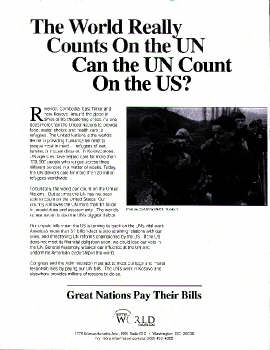
Based on this research, InterAction sought grants from the Ford and MacArthur Foundations for the three-year campaign now underway. GC will focus initially on five cities: Atlanta, Baltimore, Davis/Sacramento, Minneapolis, and Pittsburgh. Seattle will be added when additional funding becomes available. Grassroots advocates in these cities will be mobilized, trained, and linked with each other via e-mail and Web networks. At the national level, the project will encourage Congressional visits to developing nations and Congressional staff briefings to help policymakers understand how foreign assistance programs that promote global development advance U.S. interests. To reach the media, GC will organize educational conferences for journalists and media training for grassroots supporters to improve coverage of global issues.
A key criterion for selection of a city was that one or two of InterAction’s 160 affiliated members have headquarters there and are willing and able to provide local assistance and resources throughout the three years. The cities must also have organized groups from the population groups that GC has targeted, as well as institutions (academic, religious or corporate) willing to lend support to local initiatives. The city’s importance in terms of Congressional leadership and media markets was also considered.
With the help of InterAction’s member agencies, GC aims to mobilize community leaders on behalf of global engagement, educate members of Congress who represent those cities, foster sustained dialogue between the members and their constituents, and improve media coverage of global issues in each target city.
InterAction is also targeting population groups including religious and social justice activists who are committed to alleviating hunger and poverty, churches across the country that provide for and resettle refugees, refugees themselves who often keep close ties to their home countries, African Americans, Latinos, and Asian Americans who are concerned about issues in Africa, Latin America and Asia, college students and professionals in their 20s who are idealistic about the potential for world change, those who travel abroad or join the Peace Corps, and women in each of the groups.
GC will engage these groups in a national dialogue with policymakers and the media that draws connections between their own interests and the need for engagement with the developing world. Opportunities will be created for regular exchange within each population group and with policymakers and the media, according to Aviles.
Paula Hirschoff is an editor of Hunger Notes and a Washington-based writer/editor.
Asia’s Economic Crisis
There is plenty of blame to go around when it comes to explaining the cause of the economic meltdown that has many Asian countries in its grip. On the global level, the economic policies espoused by the United States, the World Trade Organization (WTO), the International Monetary Fund (IMF), and the World Bank, added to the activities of the international investors and currency speculators, all share responsibility. On the national level, unwise investment choices, lax banking regulations, corruption, excessive public and corporate debt, excessive expansion of credit and inadequate foreign currency reserves all played their part.
From the late 1980s until mid-1997, Southeast Asian currencies were set at a fixed exchange rate tied to the U.S. dollar. As the dollar lost value against the yen, their exports to Japan and Europe became cheaper and labor and land in the region also became cheaper, so foreign money flooded in and many Japanese manufacturers moved their factories to Southeast Asian countries. Although this resulted in higher income and a strengthening of the ASEAN currencies, the authorities did not allow them to rise against the dollar. High interest rates and undervalued currencies attracted even more foreign money. In 1995, however, when the United States and Japan agreed that the yen was overvalued and took steps to devalue it, resulting in the dollar appreciating from ¥80 to ¥130, Southeast Asia’s low-cost advantages began to be lost, for the ASEAN nations’ currencies were still pegged to the dollar. As exports became more expensive in Europe and Japan, long term investment became less attractive to Japan, growth slowed drastically, the current account (balance of trade) grew to a negative 8 percent, and ASEAN currencies came to be seen as overvalued. Thailand’s baht was the first to be sold short, in February, 1997 and again in May, and on July 2nd, the Thai government gave up on supporting the baht and let it float.
The float, however, was only the beginning of Thailand’s troubles. Currency speculators dumped baht, driving its value further down. Thailand was forced to rely on short-term loans at high interest rates to finance its current account deficit. The fact that many of its long-term loans had been used for real-estate speculation meant that many of them could not be repaid when called and this led to a rash of bank and business failures and large numbers of employee layoffs. Thailand was forced to seek IMF aid.
The fall of the baht made investors nervous about other Asian currencies. Soon the Indonesian rupiah was under attack and had fallen to less than half of its previous value. The domestic consequences of bank and business failures and job loss were worse than Thailand’s so that Indonesia, too, was soon forced to request IMF loans.
Next, foreign investors and speculators, in November, pulled their short-term loans out of South Korea. Its foreign currency reserves were soon depleted and it, too, fell into the clutches of the IMF.
The Asian economies were certainly not blameless for what happened. Thailand could have mobilized more domestic capital and relied less on foreign loans. It could have regulated foreign investment more closely so that the abrupt “cut and run” behavior that so exacerbated the situation could not have happened. It could have regulated its own banking industry more carefully so that there wouldn’t have been so many of the speculative investments that turned into unredeemable loans.
Many of the same “could haves” apply even more to Indonesia. Its authoritarian, nepotistic Suharto government has been even more dependent upon short-term foreign investment and characterized by more lax banking regulation than Thailand.
In South Korea, the chaebol, with their high debt-to-capital ratio, politically-motivated investment decisions and their close ties to the banking community and the latter’s practice of overextended loans, were highly vulnerable to investment decisions made abroad.
Notwithstanding the misjudgments of the Asian nations, events beyond their control had much to do with their troubles. In 1971, with the abandonment of the Bretton Woods system of fixed exchange rates between major currencies linked with gold, economic growth was freed from the constraints of a relatively inflexible monetary supply, but the door was also opened to speculation in currencies, an aggravating factor, if not the major cause of Asia’s present economic troubles.
Another external factor was the deregulation/free-market-above-all measures of the Reagan/Thatcher governments, policies also adopted by the IMF and World Bank. These measures, together with the debt crisis of the early 1980s, led to a rash of corporate mergers, buyouts, and bankruptcies, changes accelerated by the 1987 stock market crash. These changes shifted the center of economic activity and power from producers and marketers to financiers– merchant banks, institutional investors (managing pension and mutual funds), stockbrokers, currency speculators, etc.
These changes resulted in an unprecedented concentration of financial power and an attitude that finance capital and its manipulations are the essence of economic activity. In 1975, about 80 percent of foreign exchange transactions went to pay for the production or trade of goods and services; the remaining 20 percent was in expectation of profit from the buying and selling of currencies themselves, based on their changing values. Since then, currency deregulation, the “electronification” of money and the computerization of market systems have made currency trading much quicker and transaction costs much lower. Thus, today we find that a mere 2.5 percent of foreign currency exchange is to pay for goods and services and 97.5 percent is speculative. About $2 trillion in currencies is now traded each day. “This is equivalent to the entire gross domestic product (GDP) volume of the United States being turned over via currency trading every three days.” Banks are now only a minority player in a game dominated by institutional investors, but even they now derive 30 to 50 percent of their profit from currency transactions rather than interest from loans.
The changing value of currencies, a source of great wealth for speculators, is a threat to manufacturing business and national governments and economies. Total central bank reserves worldwide total about $600 billion, equivalent to only a few hours of currency trading, so if the traders make a concerted “attack” on a particular currency, no government, even that of the United States, has sufficient dollar reserves to defend its currency. The irony and injustice of this situation is that when a nation’s economy is brought to its knees by the currency speculators and must call on the IMF for help, it is the ordinary citizens who bear the brunt of the austerity measures mandated by the IMF through unemployment and cutback of social, educational, and medical services.
While speculators can profit handsomely from fluctuations in the value of currency– they thrive on instability– manufacturing businesses are hurt by uncertainty and instability. For example, suppose a Japanese or American firm, attracted by low land and labor costs, sets up a factory in Thailand. It converts dollars or yen into baht to buy the land and build the factory. In operating it and selling its product, most transactions are in baht. In the meantime, however, if the value of the baht drops by half, a profit earned within Thailand will be greatly reduced when converted into yen or dollars. If the owner should decide to liquidate the business and repatriate the proceeds, half the value of the investment is lost simply because of the baht’s decline in value.
The IMF is providing $17.2 billion for Thailand, $43 billion for Indonesia, and $57 billion for South Korea. There are, of course, strings attached and the aid will be dribbled out as the IMF’s conditions are met. Some of these are reforms that most everybody agrees should have been made long ago: freeing central banks from political control, opening the finance sector to public scrutiny (thereby reducing cronyism and corruption in the granting of loans), requiring reasonable reserves to back up loans, etc. In Indonesia, the breakup of the cartels and monopolies that have made some of President Suharto’s family and friends wealthy is part of the IMF requirements.
It is what the IMF is demanding that nations do vis-à-vis the outside world that worries the Asian nations and arouses suspicion that the IMF package is simply a plot by the multinationals to gain control of national firms on the cheap. For example, in Korea, the package requires raising the limit on foreign ownership of Korean stocks to 55 percent, permitting the establishment of foreign financial institutions in Korea, fully opening the financial/capital market, diversifying import sources, abolishing the car classification system (thus making it easier for U.S. and Japanese automakers to break into the Korean market), etc. These measures, plus the requirements that the national governments reduce taxes and spending, are seen by social critics as virtual enslavement to the IMF. Why, they ask, should Thais, Indonesians, and Koreans have to suffer for the greed of money speculators?
Although there is anger and bitterness that the “Asian Tigers” have so suddenly become housecats in the lap of the IMF, there is also much self-reflection and a determination that this shall not happen again. There is a resolve to rely more on domestic capital and less on foreign capital, a will to strengthen the of-late much-neglected agricultural sector, recognizing a strong farm economy provides a cushion against urban unemployment and a higher degree of national self-sufficiency. There is also talk of a retreat from rampant materialism and consumerism, and a return to spiritual values and simpler living. This ill wind may, indeed, blow some good. If it leads to strengthened local communities, greater democracy and perhaps even new media of exchange, it could form a bulwark against the relentless and undemocratic global economy.
 Lewis and his wife Rose Lewis edit Windows East and West, a Society of Friends publication on Asian issues. Lewis teaches Japanese at Chemeketa Community College in Salem, Oregon. Both are active in the Friends Community.