

Hunger and Poverty Facts 2008
World Hunger
Education Service
Hunger in the United States
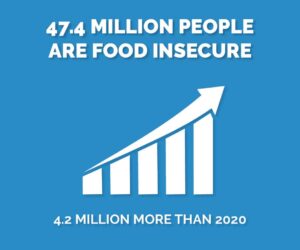
- In 2006, 35 million people, 10.9 percent of
households, were food insecure at at least some time
during the year. (USDA 2006)
- In 2006, 11 million people, 4.0 percent of U.S.
households, had very low food security—meaning that the
food intake of one or more adults was reduced and their
eating patterns were disrupted at times during the year
because the household lacked money and other resources
for food.(USDA 2006)
- The typical food-secure household spent 31 percent
more on food than
the typical food-insecure household of the same size and
household composition. (USDA 2006)
- Just over half of all food-insecure households
participated in one or more of the three largest Federal
food and nutrition assistance programs. (USDA 2006)
- The United States changed the name of its
definitions in 2006 that eliminated references to
hunger, keeping various categories of food insecurity.
This did not represent a change in what was measured.
Very low food insecurity (described as food insecurity
with hunger prior to 2006) means that, at times during
the year, the food intake of household members was
reduced and their normal eating patterns were disrupted
because the household lacked money and other resources
for food. This means that people were hungry ( in the
sense of "the uneasy or painful sensation caused by want
of food" [Oxford English Dictionary 1971] for days each
year. (USDA 2006)
Poverty in the United States
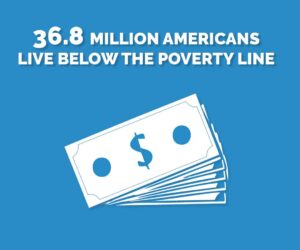
- 36.5 million Americans — roughly one in eight
— live in poverty. Today’s poverty rate is higher than
it was during the last recession. (CBPP
2007)
- 15.4 million Americans live in extreme poverty. In
other words, their family’s cash income is less than
half of the poverty line, or less than about $10,000 a
year for a family of four. (CBPP 2007)
- 16 million low-income households either paid more
for rent and utilities than the federal government says
is affordable or lived in overcrowded or substandard
housing. (CBPP 2007)
- 47 million Americans — more than one in every seven
— did not have medical insurance. This number has risen
every year. (CBPP 2007)
Programs to assist low income
people
Perhaps the four principal programs
that provide income and other assistance for poor people are
the minimum wage, the Earned Income Tax Credit (EITC), the
Temporary Assistance to Needy Families (TANF) program, and
Food Stamps. Other important programs, not discussed
here, include Social Security, Medicaid, and the Woman’s,
Infants, Children (WIC) program.
Minimum wage The United
States enacts a minimum wage (as do individual states)
that tries to establish a floor for what can be paid as
a wage by firms.The minimum wage from 1998 to 2007
remained constant at $5.15 (in contrast, the wage
paid to federal workers was raised every year over that
period). With inflation, this has meant a 26 percent
decline in the real minimum wage over the period. In
2006, the (official U.S.) poverty level for a family of
4 was $20,000. With a 40 hour week, a family of 4 with
one minimum wage earner would earn $10,300, only half of
the poverty level. In 2007, the minimum wage was
increased, and goes up in steps to $7.25 in 2009,
resulting one wage earner earnings of $14,500—still far
below the poverty level. And although
13 million workers
will receive a $2.10 hourly raise,
it is not indexed to inflation, which means that the
real benefits will be eroded by inflation.
The Earned Income Tax Credit (EITC).
The Earned Income Tax Credit is the mechanism through
which, by filing a tax return, low income people and
families can receive an income supplement. For a family
of four—husband and wife and two children—with one
parent only earning the current minimum wage of $5.15 an
hour, the annual family income would be $10, 712. This
would qualify the family for a $4,290 earned income tax
credit. (This is not enough unfortunately to get the
family of four over the poverty line.) Along similar
lines, the Child Tax Credit benefits families with
incomes above $11,400 with an annual tax credit of up to
$1000 per child. Studies have indicated that the range
of eligible families not applying is between 18-25
percent (Holt 2006).
Temporary Assistance to Needy
Families (TANF) In 1996, TANF replaced the Aid to
Families with Dependent Children program, which had been
in existence since 1935. The TANF program provides block
grants to states to provide assistance to needy
families. States have discretion on how to use the
funds. The number of TANF recipients fell substantially
in the first five years of the program, in part due to a
significant increase in the number of single parents who
work, but also due to other factors, such as an
inability of families to meet the regulations. Studies
of families that stop receiving TANF assistance show
that 60 percent of former recipients are
employed—typically at poverty-level salaries between $6
and $8.50 an hour—while 40 percent are not employed.
Lack of available child care can well keep single
mothers from working as required, for example. Other
factors that undermine TANF’s contribution to people’s
security include a five-year time limitation on
benefits; permitting benefits to legal immigrants only
5 years after establishing legal immigration, and a
declining level of real funding for the program (Coven
2005).
Food Stamps To receive food
stamps, people’s net income must be below the poverty
line (there are some exceptions). The average benefit
per person is $21 per week, or $1 a meal, an amount
which is extremely difficult to live on. Families
routinely find themselves with ‘more month than money.’
Approximately 21 million people receive food stamp
benefits, about 57 percent of the 37 million people who
live in poverty. Unfortunately, the food stamps do not
have much buying power. Poor families in urban areas
struggle to find healthy food because supermarkets are
few and far between. In addition, junk food (chips,
soda, candy) is often cheaper and more accessible than
fresh fruits and vegetables. Those without transport
must find ways to get to the larger markets and return
home with their groceries. Food justice, i.e. access to
healthy and affordable food is a continuing challenge
for minority and low-income Americans.
Bibliography
Center on Budget and Policy Priorities (CBPP).
2007. "Poverty and Hardship Affect Tens of Millions of
Americans."
http://www.cbpp.org/12-20-07pov.htm
Coven, Martha. 2005. “An
Introduction to TANF.” The Center for Budget and Policy
Priorities.
http://www.cbpp.org/1-22-02tanf2.htm
Holt, Eric. 2006. “The Earned Income Tax
Credit at Age 30: What We Know.” The Brookings Institution.
(2006).
http://www3.brookings.edu/metro/pubs/20060209_Holt.pdf
United States Department of Agriculture. Economic
Research Service. Household Food Security in the United
States, 2006 ERR-49
Wikipedia. 2008. The
Personal Responsibility and Work Opportunity Reconciliation
Act.
http://en.wikipedia.org/wiki/Personal_Responsibility_and_Work_Opportunity_Reconciliation_Act