 |
 |
|
|
| DEPARTMENTS | |||

|
|||

|
|||

|
|||

|
|||

|
|||

|
|||

|
|||
| YOU CAN!... | |||
|
|||

|
|||
|
|||
|
|||
| MORE ABOUT HUNGER NOTES |
|||
 |
|||

|
|||

|
|||
|
|||
|
|||
|


The world financial, food and hunger crisis
Lane Vanderslice
(Updated November 11, 2008) The world food crisis has been replaced in large part by the world financial crisis. Both crises have resulted principally by the operation of the world economic system and have great impact on people who are poor and hungry. The major new element is the financial crisis. Financial (and other) institutions all over the world took risks that were not prudent financial risks, and when, instead of continued growth in asset prices such as real estate, oil and food, there began to be a decline in prices for housing and other items, these institutions such as banks (e.g. Wachovia), insurance firms (such as AIG), investment banks (such as Lehman Brothers and Merrill Lynch) did not have enough capital to meet their obligations. They thus would have had to go into bankruptcy and default on their obligations. Many other institutions hold their obligations, so that they would have to revalue downward the financial instruments issued or insured by faltering companies, thus in turn throwing the financial stability of many other institutions in question.
This financial crisis is having a great impact on the world's economies. Demand for goods is falling--US automobile sales have fallen by 25 percent from last year's levels, for example. This has affected developing country economies, as demand for their products has decreased, reducing employment and incomes in these countries. The one bright spot is that commodity prices, including the price of agricultural commodities such as rice, have fallen substantially.
(May 8, 2008) The facts: food prices have soared. To take the key example: rice, the staple food of billions of people, more than doubled from 2003 through March 2008.1
This is a crisis for the poorest people in the world. 2.6 billion people live on $2 a day or less. They spend approximately 50 percent of their income on food. Thus a person living on $2 a day spends $1 a day on food. When food prices go up by 100 percent, s/he must spend $2.00 a day on food or purchase less food. The result is s/he purchases less food, leading to increased hunger, and has much less left over for other necessities such as housing.
(This is a crisis that is really pretty much unimaginable for most people living in the United States. If you do want to imagine it--or live it--imagine yourself living in your garage--you definitely cannot go in your house for anything--with $2 a day to spend on everything. How much do you live on a day now? If you are a student, don't just think of your allowance. The basic way to calculate how much you are living on is to take your entire family's income, divide by the number of people in the family, and then divide by 365 days per year. How much is this for your family--and how many times greater is it than $2 per day? The median family income in the United States was $48,201 and the average family size was 3 people (rounding slightly). So the average income per day per person in the United States was $44 or 22 times greater than the poorest people in the world. So it is very difficult for our human imaginations to grasp what it would be like to live on 5 percent of our current income.)
Recognizing that there is a crisis for most poor people in the world, it must also be recognized that higher food prices represent a significant opportunity for a substantial fraction of the world's poorest people--perhaps 30 percent?--that are farmers with enough land--at least several acres--to earn most of their living from working their land.
What are the causes of the increase in food prices and the crisis?
Economists (I am one) would say demand is growing faster than supply. What are the factors affecting the demand for food? What are key factors affecting the supply of food?
Demand side:
There has been strong economic growth for the world economy over the past 10 years or so. There has been considerable economic growth in China and India, two key countries that have very large, and relatively poor populations. This has pushed up the demand for food in these countries, and this has happened as well in other developing countries.
The demand for food is (what economists call) price inelastic. That is to say, the quantity people demand of food does not vary much with changes in prices. If a one percent change in price leads to a less than one percent change in quantity demanded, then the demand is said to be price inelastic. (Wikipedia definition of price elasticity) Price times quantity demanded = total amount spent on food. Supply has tended grow faster than demand over the past 50 years or so, which has worked in the food consumer's favor, as the percentage of the budget that each consumer spends on food has tended to decrease. (Now however, for some period of time at least, the tables have turned.) With price inelasticity, changes in the quantity supplied will lead to large (percentage) changes in the price.
Speculation Commodity speculation has been widespread. Speculation can be good or bad, and in fact it can be good and bad at the same time. Speculators are basically institutions with money that try to buy a particular commodity such as rice at a low price and sell it at a higher price. The reason why this is good is that it diverts commodities from a low value use to a higher value use. The bad is that it may well take away commodities from poor people (see fuller explanation below under production for export), it can introduce a certain panic leading to hoarding and higher prices than would otherwise be the case, and there may well be ways that the markets can be 'gamed' (manipulated) leading to higher prices. (Enron and other companies manipulated prices in the California electricity market (see Wikipedia's California electricity crisis), and this may well be true for food commodities as well.)
Supply side:
4A major factor affecting the supply of food has been the diversion of crop land to fuel production. This is clearly evident in the United States and Brazil.
There has also been considerable emphasis on production for export in developing countries (principally organized by international donors such as the World Bank and the United States Agency for International Development). With this emphasis, the agricultural production of developing countries is now directed to a greater extent toward producing for export to developed countries rather than to producing goods for their own people. This has meant for example that US consumers are able to buy a cantaloupe from Guatemala rather than the Guatemalan farmer producing corn for the local market. US consumers can pay more for the cantaloupe--say $1.50--than the Guatemalan farmer could obtain by selling corn in Guatemala--say $1.30. What this does not take into account is that the corn--in actual value to actual human beings--may be worth more--probably even far more--than the cantaloupes. The reason is that production is being taken away from what poor people consume (corn in this case) and directed toward what relatively extremely rich people (people in the United States, Canada, and countries of western Europe) purchase. So poor people in developing countries that must purchase food (every poor person in urban areas, and most in rural ones) suffer.
There have also been certain shortfalls in production. Australia for example, has had droughts in the past several years leading to reduced grain production.
Support for agricultural development has been minimal. Assistance to agriculture by developed countries and multilateral development banks has been minimal, and, though some countries have adequately supported their agriculture sector including India and China, others have not, including many and perhaps most countries of Africa. Agricultural producers, especially the poorest, in Africa and elsewhere have been exploited or neglected by governments.
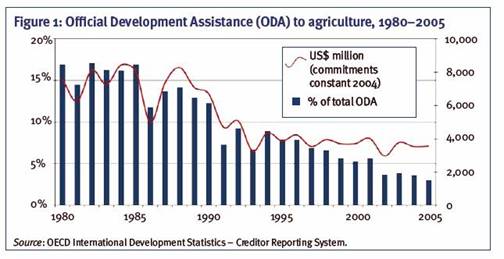
Assistance to agriculture by developed countries and multilateral development banks has fallen dramatically. Agriculture’s share of Official Development Assistance (ODA), including funding from the World Bank, declined sharply from 1985-86 to 2005-06, from over 12 to just 3.1 percent. 2 In absolute terms, support for agriculture went from a high of about $8 billion in 1984 to $3.4 billion in 2004.3 Although donors have declared that they wanted to increase their support for agriculture and rural development, these declarations have not resulted in actual funding increases for agriculture, as Figure 1 below shows.
Nor has this funding been directed properly, in my opinion. There are two major faults. First, there is an emphasis on 'high value' agriculture--essentially agricultural production for rich consumers, instead of agriculture that benefits poor people. Secondly, there is an emphasis on highly productive areas, instead of less productive areas, which unfortunately is often where the poor people live, very frequently because they have been marginalized by the societies in which they live. Thirdly, US agriculture assistance (and other assistance such as food aid) has been tied to some degree to acceptance of genetically modified organisms (GMOs) which many developing countries, for good reasons, do not want to accept.
Lane Vanderslice is the editor of Hunger Notes
1. FAO. 2008 "The FAO Rice Price Update - April 2008." The FAO All Rice Price index went up by 132 percent. Thai white second grade for example went up from $201 per ton to $472. http://www.fao.org/es/ESC/en/15/70/highlight_533.html
2. OECD/DAC, Statistical Annex of the 2007 Development Co-operation Report, December 2007
3. World Bank. 2007. World Development Report 2008: Agriculture for Development. pp 41-42. While this decline was common to bilateral as well as multilateral aid, the decline in the latter was more pronounced.
4. Food and Agriculture Organization. 2002. Reducing Poverty & Hunger: The Critical Role of Financing for Food, Agriculture and Rural Development http://www.fao.org/docrep/003/Y6265e/y6265e00.htm