 |
 |
|
|
| DEPARTMENTS | |||

|
|||

|
|||

|
|||

|
|||

|
|||

|
|||

|
|||
| YOU CAN!... | |||
|
|||

|
|||
|
|||
|
|||
| MORE ABOUT HUNGER NOTES |
|||
 |
|||

|
|||

|
|||
|
|||
|
|||
|


Would the United States government pass the ‘good Samaritan’ test?
Lane Vanderslice
(World Hunger Education Service Testimony before the House Foreign Operations Subcommittee)
I am Lane Vanderslice, board member of the World Hunger Education Service (WHES) and editor of its principal publication Hunger Notes (www.worldhunger.org). WHES has been in existence for 33 years informing people about world hunger and poverty issues. WHES has not received funding from the United States Government in any of the past three years. We would like to thank this committee for its long record of permitting public testimony. Foreign policy is too important to be left to the foreign policy apparatus.
In this testimony, we are principally criticizing the current United States security/foreign policy approach. In addition we make observations about funding.
We have no problem with the United States government having as a principal focus protecting the United States from possible foreign threats including military measures. However, the United States has embarked on a course which
- overemphasizes its own security
- has a concept of its own security which is in fact narrowly conceived, and which vastly overemphasizes a military response to that security.
Let us look at the facts. For 2007 in the discretionary U.S. budget (basically one that does not include Medicare and Medicaid)
Discretionary budget (all numbers in $billions)
Security funding $498
Non-security funding $382
Supplemental budget
Security funding $184
Non-security funding $8
Total security funding $682
Total funding $1072 [1]
Thus 64 percent of the U.S. budget is used for U.S. security. This is appalling.
We note in passing that this (what we believe to be) overemphasis on security has had important consequences for the American people in addition to the one we discuss more fully below, including inaction on vital economic security issues facing large numbers of U.S. citizens.
These economic security issues include:
- 36.5 million Americans — roughly one in eight — live in poverty. Today’s poverty rate is higher than it was during the last recession.
- Some 12.6 million households, containing 35.5 million people, lacked access to adequate food at some point during the year because they didn’t have enough money for groceries.
- 16 million low-income households either paid more for rent and utilities than the federal government says is affordable or lived in overcrowded or substandard housing.
- 47 million Americans — more than one in every seven — did not have medical insurance. This number has risen every year.
Now let us turn to the security budget.
The major criticism we have is just this. The security budget is almost entirely defined as protecting us against enemies. This should be done. But security is much more than that. It is understanding people and helping them (or permitting ourselves to be helped, if we need help). The major way in which security has happened in history is not that enemies have been conquered, but that people have agreed not to fight and to live in peace. The foreign policy apparatus of the United States, including this committee, needs to focus its policy much more on understanding others and helping them. One quote from the Bible illustrates the needed direction. (A similar message of understanding and helping others, especially those in need, is a key element of other major religions.)
On one occasion an expert in the law stood up to test Jesus. "Teacher," he asked, "what must I do to inherit eternal life?" "What is written in the Law?" he replied.
"How do you read it?" He answered: " 'Love the Lord your God with all your heart and with all your soul and with all your strength and with all your mind'; and, 'Love your neighbor as yourself.'" "You have answered correctly," Jesus replied. "Do this and you will live." But he wanted to justify himself, so he asked Jesus, "And who is my neighbor?"
In reply Jesus said: "A man was going down from Jerusalem to Jericho, when he fell into the hands of robbers. They stripped him of his clothes, beat him and went away, leaving him half dead. A priest happened to be going down the same road, and when he saw the man, he passed by on the other side. So too, a Levite, when he came to the place and saw him, passed by on the other side. But a Samaritan, as he traveled, came where the man was; and when he saw him, he took pity on him. He went to him and bandaged his wounds, pouring on oil and wine. Then he put the man on his own donkey, took him to an inn in Jericho and took care of him. The next day he took out two silver coins and gave them to the innkeeper. 'Look after him,' he said, 'and when I return, I will reimburse you for any extra expense you may have.'
"Which of these three do you think was a neighbor to the man who fell into the hands of robbers?"
The expert in the law replied, "The one who had mercy on him." Jesus told him, "Go and do likewise." (Gospel of Luke, chapter 10 verses 25-37.)
What mercy has the U.S. government--our government-- had? We have the capability to 'project force' everywhere, and do so when our government feels it is necessary. We are now engaged in very large wars in Afghanistan and Iraq, our sea power roams the seas of the globe, we are setting up a new military command in Africa, we have bombed villages in Somalia in order to try to kill suspected terrorists who may have been in the villages, we have been willing to finance wars in many countries including Nicaragua and El Salvador.... Our security force is very large but where is our mercy? To discuss this, we now turn to the function 150 account.
The function 150 account is part of the security budget, and it does include ‘security of others’ items. Running down the list of State Department and other international programs[2], we estimate that of the total of $25.896 billion outlays in 2007 falling under Foreign Operations, $14.107 billion or approximately 55 percent could be counted as security of others expenditure.[3] (For the State Department table that was used for this estimate see either the citation or Hunger Notes pdf of the relevant table.) So using this approximate measure for the security of others expenditure, we have: security of others as a proportion of total U.S. security expenditure equals $14 billion divided by the total U.S. security budget of $682 billion. Thus expenditure on the security of others is approximately 2 percent of the U.S. security budget. This is far from sufficient. Both the overemphasis on our own security, especially the military emphasis, and our minimal concern for the welfare of others, is a fundamental problem in our relations with the developing world.
Two areas where much more should be done: assisting developing country agriculture and reducing malnutrition among pregnant women and the very young.
Agriculture
Agriculture’s share of Official Development Assistance (ODA) declined sharply from 1985-86 to 2005-06, from over 12 to just 3.1 percent. [4] In absolute terms, support for agriculture went from a high of about $8 billion in 1984 to $3.4 billion in 2004.[5] Although donors have declared that they wanted to increase their support for agriculture and rural development, these declarations have not resulted in actual funding increases for agriculture, as Figure 1 below shows.[6]
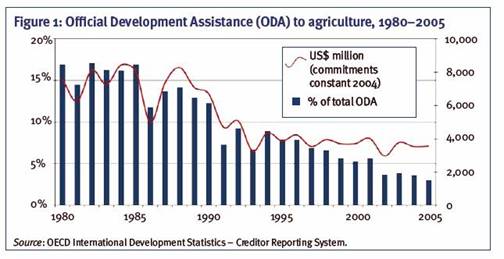
This is certainly true for the United States, where the proliferation of initiatives and earmarks from both the administration and Congress has tended to squeeze out funding for agriculture.[7] WHES supports substantially increased funding for agriculture, including support for the International Fund for Agricultural Development’s new replenishment.
Child malnutrition
This subcommittee has been a long-term supporter of Child Survival efforts. We commend the subcommittee for its concern. We would like to call attention to a key issue: malnutrition is still the largely preventable cause of 2.2 million—approximately 25 percent—of all child deaths. We believe that this key issue needs to be addressed.
In summary: We believe that the United States does not focus sufficiently on the security of others, especially ordinary people, using avenues of cooperation opened up by this approach to achieve a greater level of security for all. We urge this subcommittee and full committee to take the lead in funding cooperative efforts that address key needs of developing countries by—if need be—reducing other aspects of U.S. security funding. We have mentioned—too briefly—two desirable areas for such increased cooperation.
Thank you for the opportunity to present this testimony. We would be happy to provide a written response to any questions you may have.
[1] Office of Management and the Budget Summary tables (http://www.whitehouse.gov/omb/budget/fy2009/pdf/budget/tables.pdf)
[2] State Department Summary and Highlights Function 150 http://www.state.gov/documents/organization/100014.pdf
[3] Not counted as ‘security of others’ expenditure: Economic Support Fund, International Narcotics and Law Enforcement, Andean Counterdrug Initiative, Foreign Military Financing,, and Broadcasting Board of Governors. Counted as half ‘security of others’, half U.S. security: Department of State (DS) Diplomatic and Consular Programs, Embassy Security Programs, and Non-proliferation, Anti-terrorism, and Demining Programs
[4] OECD/DAC, Statistical Annex of the 2007 Development Co-operation Report, December 2007
[5] WDR, pp 41-42. While this decline was common to bilateral as well as multilateral aid, the decline in the latter was more pronounced.
[6] FAO, Reducing Poverty & Hunger
[7] Currently, only about 4 percent of the USAID budget is available for unencumbered use to promote the largely microeconomic reforms that can speed economic growth in poor countries. Another 20 percent or so is available for promoting economic growth in a particular sector or for a particular country or region. For all donors, aid directed at agriculture and economic growth (including economic support infrastructure) amounted to 19 percent of the total. (OECD DAC 2005 statistical Annex)