 |
 |
|
|
| DEPARTMENTS | |||

|
|||

|
|||

|
|||

|
|||

|
|||

|
|||

|
|||
| YOU CAN!... | |||
|
|||

|
|||
|
|||
|
|||
| MORE ABOUT HUNGER NOTES |
|||
 |
|||

|
|||

|
|||
|
|||
|
|||
|


New U.S. Study Projects Hunger Gaps
Steve Hansch
In
addition to the FAO studies of global food and hunger trends
(see the Hunger Notes article Trends and Current Status of Malnutrition,
the U.S. Government has also re-joined the debate about
whether world hunger is getting better or worse.
A recent report by the U.S. Department of
Agriculture, World Food Security, questions the likelihood of
the World Food Summit goal of halving the world's hungry
people by 2015, estimating that the actual reduction has
been and will be less
than half that needed to reach the goal.
In
anticipation of the summer 2002 World Food Summit in Rome,
economic staff at the USDA wrote the recent "Food
Security Assessment" (GFA-13) about hunger in 67 of the
lowest-income countries. It continues the food assessments
conducted in the 1970s and from 1990 to 1992.
Taking
into account a range of economic indices, and projecting
forward the "food gap" in developing countries,
the authors forecast an average 1.6 percent decrease each
year in the
number of hungry people.
The
authors conclude that food security deteriorated between
2000 and 2001, largely due to a drop in food production
which itself followed from economic contractions.
A more fundamental reason for food insecurity is
poverty. According to the USDA estimates, consumption levels
in 51 of the 67 countries for 20 percent or more of the
population are below nutritional requirements, due to the
low incomes of this part of the population. The situation
for the poorest people in the other 16 countries is also
dire.
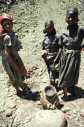
Photo: M. Marzot/FAO
Women drawing water from a well in Ethiopia. Drough and inadequate water suppy in most of Africa continues to be a major problem for poor people.
The
report shows how the biggest effect of food aid is not in
addressing overall food shortages, but in creating access to
food among the poor. Food
supply alone is not the main problem in many areas:
"most of the food aid was given to countries
such as India, Bangladesh, Ecuador, Guatemala, Georgia and
Azerbaijan, that did not need any food aid at the average
national level, according to our estimate."
US food aid in the year 2000 had its main benefit
by improving food access, addressing the problem of
the distribution gap.
The
authors conclude that food aid, at present levels, can only
address a small fraction of the overall hunger problem.
"While food aid can play a useful role in the
fight against hunger, its contribution is limited and cannot
be the sole remedy to the hunger problem."
The authors point to food safety net programs as
effective efforts that some governments, like China.
"Integrating international and national
resources in designing safety net programs can be very
effective instruments for mitigating the effects of shocks
and can in this way serve as adjuncts to longer-term food
security strategies.
In
the long run, economic and income growth represents the most
important basis for reduction of hunger, as the authors show
in Bangladesh and India where the lowest income groups have
achieved greater purchasing power.
"Today, only the bottom income quintile in
Bangladesh fails to meet their nutritional requirements,
compared with the bottom two quintiles in 1995. ... In
India, food supplies have continued to increase.
The country has become a significant grain exporter
while food stocks are at record levels."
The
authors review the particular case of many countries. When looking specifically at Afghanistan, they find that the
crisis there will continues to lead to a large food
shortfall, roughly 3 million metric tons this year.
"The situation is projected to remain acute over
the next decade, requiring perhaps as much as 3.3 million
tons annually to meet nutritional needs."
copyright