 |
 |
|
|
| DEPARTMENTS | |||

|
|||

|
|||

|
|||

|
|||

|
|||

|
|||

|
|||
| YOU CAN!... | |||
|
|||

|
|||
|
|||
|
|||
| MORE ABOUT HUNGER NOTES |
|||
 |
|||

|
|||

|
|||
|
|||
|
|||
|


Growing demand for soybeans threatens Amazon rainforest
Lester R. Brown
(January 10, 2010) Some 3,000 years ago, farmers in
eastern China domesticated the soybean. In 1765, the first
soybeans were planted in North America. Today the soybean
occupies more U.S. cropland than wheat. And in Brazil, where
it spread even more rapidly, the soybean is invading the
Amazon rainforest.
For close to two centuries after its introduction into the
United States the soybean languished as a curiosity crop.
Then during the 1950s, as Europe and Japan recovered from
the war and as economic growth gathered momentum in the
United States, the demand for meat, milk, and eggs climbed.
But with little new grassland to support the expanding beef
and dairy herds, farmers turned to grain to produce not only
more beef and milk but also more pork, poultry, and eggs.
World consumption of meat at 44 million tons in 1950 had
already started the climb that would take it to 280 million
tons in 2009, a sixfold rise.
This rise was partly dependent on the discovery by animal
nutritionists that combining one part soybean meal with four
parts grain would dramatically boost the efficiency with
which livestock and poultry converted grain into animal
protein. This generated a fast-growing market for soybeans
from the mid-twentieth century onward. It was the soybean’s
ticket to agricultural prominence, enabling soybeans to join
wheat, rice, and corn as one of the world’s leading crops.
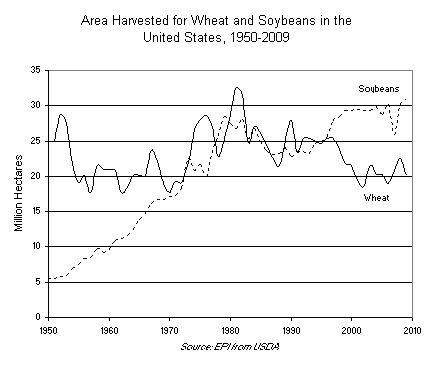
U.S. production of the soybean exploded after World War II.
By 1960 it was close to triple that in China. By 1970 the
United States was producing three fourths of the world’s
soybeans and accounting for virtually all exports. And by
1995 the fast-expanding U.S. land area planted to soybeans
had eclipsed that in wheat.
When world grain and soybean prices climbed in the
mid-1970s, the United States—in an effort to curb domestic
food price inflation—embargoed soybean exports. Japan, then
the world’s leading importer, was soon looking for another
supplier. And Brazil was looking for new crops to export.
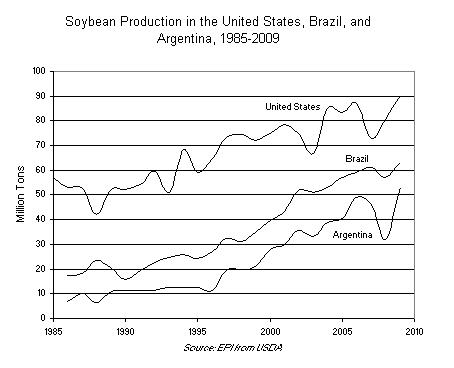
The rest is history. In 2009, the area in Brazil planted to
soybeans exceeded that in all grains combined.
At about the same time the soybean gained a foothold in
Argentina, where it staged the most spectacular takeover of
all. Today more than twice as much land in Argentina
produces soybeans as produces grain. Rarely does a single
crop so dominate a country’s agriculture as the soybean does
Argentina’s. Together, the United States, Brazil, and
Argentina produce easily four fifths of the world’s soybean
crop and account for 90 percent of the exports.
During the closing decades of the last century, Japan was the leading soybean importer, at nearly 5 million tons per year. As recently as 1995, China was essentially self-sufficient in soybeans, producing and consuming roughly 13 million tons of soybeans a year. Then the dam broke as rising incomes enabled many of China’s 1.3 billion people to move up the food chain, consuming more meat, milk, eggs, and farmed fish. By 2009 China was consuming 55 million tons of soybeans, of which 41 million tons were imported, accounting for 75 percent of its soaring consumption.
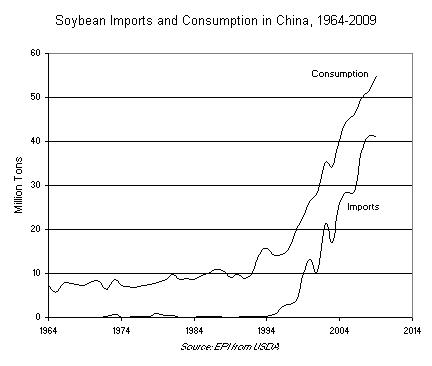
Today half of all soybean exports go to China, the
country that gave the world the soybean. Soybean meal mixed
with grain for animal feed made it possible for Chinese meat
consumption to grow to double that in the United States.
Since 1950 the world soybean harvest has climbed from 17
million tons to 250 million tons, a gain of more than
14-fold. (See
data.) This contrasts with growth in the world grain
harvest of less than fourfold. Soybeans are the
second-ranking U.S. crop after corn, and they totally
dominate agriculture in both Brazil and Argentina.
Where does the 250-million-ton world soybean crop go? One
tenth or so is consumed directly as food—tofu, meat
substitutes, soy sauce, and other products. Nearly one fifth
is extracted as oil, making it a leading table oil. The
remainder, roughly 70 percent of the harvest, ends up as
soybean meal to be consumed by livestock and poultry.
So although the soybean is everywhere, it is virtually
invisible, embedded in livestock and poultry products. Most
of the world harvest ends up in refrigerators in such
products as milk, eggs, cheese, chicken, ham, beef, and ice
cream.
Satisfying the global demand for soybeans, growing at nearly
6 million tons per year, poses a challenge. The soybean is a
legume, fixing atmospheric nitrogen in the soil, which means
it is not as fertilizer-responsive as, say, corn, which has
a ravenous appetite for nitrogen. But because the soy plant
uses a substantial fraction of its metabolic energy to fix
nitrogen, it has less energy to devote to producing seed.
This makes raising yields more difficult.
In contrast to the impressive gains in grain yields,
scientists have had comparatively little success in raising
soybean yields. Since 1950, U.S. corn yields have quadrupled
while those of soybeans have barely doubled. Although the
U.S. area in corn has remained essentially unchanged since
1950, the area in soybeans has expanded fivefold. (See
data.) Farmers get more soybeans largely by planting
more soybeans. Herein lies the dilemma: how to satisfy the
continually expanding demand for soybeans without clearing
so much of the Amazon rainforest that it dries out and
becomes vulnerable to fire.
The Amazon is being cleared both by soybean growers and by
ranchers, who are expanding Brazil’s national herd of beef
cattle. Oftentimes, soybean growers buy land from cattlemen,
who have cleared the land and grazed it for a few years,
pushing them ever deeper into the Amazon rainforest.
The Amazon rainforest sustains one of the richest
concentrations of plant and animal biological diversity in
the world. It also recycles rainfall from the coastal
regions to the continental interior, ensuring an adequate
water supply for Brazil’s inland agriculture. And it is an
enormous storehouse of carbon. Each of these three
contributions is obviously of great importance. But it is
the release of carbon, as deforestation progresses, that
most directly affects the entire world. Continuing
destruction of the Brazilian rainforest will release massive
quantities of carbon into the atmosphere, helping to drive
climate change.
Brazil has discussed reducing deforestation 80 percent by
2020 as part of its contribution to lowering global carbon
emissions. Unfortunately, if soybean consumption continues
to climb, the economic pressures to clear more land could
make this difficult.
Although the deforestation is occurring within Brazil, it is
the worldwide growth in demand for meat, milk, and eggs that
is driving it. Put simply, saving the Amazon rainforest now
depends on curbing the growth in demand for soybeans by
stabilizing population worldwide as soon as possible. And
for the world’s affluent population, it means moving down
the food chain, eating less meat and thus lessening the
growth in demand for soybeans. With food, as with energy,
achieving an acceptable balance between supply and demand
now means curbing growth in demand rather than just
expanding supply.
Lester R. Brown is the president of the Earth Policy Institute and author of "Plan B 4.0: Mobilizing to Save Civilization." This article first appeared on the Earth Policy Institute website and may be viewed at http://www.earthpolicy.org/index.php?/plan_b_updates/2009/update86