 |
 |
|
|
| DEPARTMENTS | |||

|
|||

|
|||

|
|||

|
|||

|
|||

|
|||

|
|||
| YOU CAN!... | |||
|
|||

|
|||
|
|||
|
|||
| MORE ABOUT HUNGER NOTES |
|||
 |
|||

|
|||

|
|||
|
|||
|
|||
|


Africa 2009 |
|
For more Darfur, Sudan, Chad, Central African Republic stories
For Democratic Republic of the Congo stories
For Somalia stories
For Zimbabwe stories
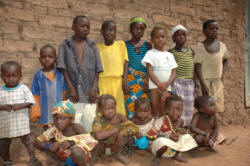
One third of children in Sikasso are underweight for their age, and for acute malnutrition, the rate in Sikasso was 16 percent, according to the most recent government survey. Photo: Phuong Tran/ IRIN
In Mali's richest region, Sikasso, malnutrition is as high as in the country's barren north, due in large part to concentration on cash crop, export-oriented production in the rich region IRIN News December 29, 2009
Millions in Kenya free primary education funds appear to have been stolen-- the World Bank and British government suspend funding for the program Afrique en ligne December 19, 2009 See Hunger Notes special report: Harmful economic systems

A mother feeds her malnourished child in the malnutrition ward in a hospital in the town of Kebri Dehar, in the Somali region of Ethiopia. Photo: David Bebber/The Times
Wealthy nations flock to farmland in Ethiopia, locking in food supplies grown half a world away, with alarming implications for hunger in Ethiopia, critics say Stephanie McCrummen Washington Post November 23, 2009 See video See Hunger Notes special report: Harmful economic systems 25 years after Live Aid, Ethiopia tries to cover up a new famine Times Online November 18, 2009 Also see Ethiopian government inaction, repression, and obfuscation is a major cause of the developing Ethiopian famine (opinion) Alemayehu G. Mariam Huffington Post November 25, 2009

Nigeria, once the worst-afflicted country in the world with an estimated 653,000 cases in 1989, appears to be free of guinea worm disease, which is a painful parasitic infection transmitted to humans through a water supply contaminated with guinea worm larvae. Photo: Vanessa Vick/New York Times
Campaign to eradicate guinea worm in hard-hit Nigeria may have worked Donald G. McNeil Jr. New York Times December 5, 2009 See more health stories
Aid to African families that take in orphaned children gives alternative to orphanages Celia W. Dugger New York Times December 5, 2009
Major economies square off over global trade deal (the WTO Doha round). South Africa calls for immediate cuts in US cotton subsidies that make it impossible for poor African cotton farmers to compete and that are in violation of WTO trade rules Jonathan Lynn and Laura MacInnis Reuters Africa December 1, 2009 African producers may litigate over US cotton subsidies Reuters Africa December 1, 2009 Brazil wins cotton war, but the US cuts no subsidies Ann Crotty Business Report December 2, 2009
A mother feeds her malnourished child in the malnutrition ward in a hospital in the town of Kebri Dehar, in the Somali region of Ethiopia. Photo: David Bebber/The Times
Wealthy nations flock to farmland in Ethiopia, locking in food supplies grown half a world away, with alarming implications for hunger in Ethiopia, critics say Stephanie McCrummen Washington Post November 23, 2009 See video See Hunger Notes special report: Harmful economic systems 25 years after Live Aid, Ethiopia tries to cover up a new famine Times Online November 18, 2009 Also see Ethiopian government inaction, repression, and obfuscation is a major cause of the developing Ethiopian famine (opinion) Alemayehu G. Mariam Huffington Post November 25, 2009
Africa population tops one billion BBC News November 18, 2009 Population explosion to stop Africa's attempt to attain MDGs AfriqueJet November 18, 2009

A new megafarm in Western Ethiopia, for palm-oil trees, sugar cane, rice and sesame. All through the Rift Valley region, there are new fence posts signifying the recent rush for Ethiopian land. In the old days, farmers rarely bothered with such formal lines of demarcation, but now the country’s earth is in demand. One fence stretched on for a mile or more, very possibly belonging to Sheik Mohammed Al Amoudi, a Saudi Arabia-based oil-and-construction billionaire who was born in Ethiopia and maintains a close relationship with the Ethiopian Prime Minister Meles Zenawi’s autocratic regime. Photo: Simon Norfolk/New York Times
Is there such a thing as agro-imperialism? Andrew Rice New York Times November 16, 2009 For further information on the takeover of developing country land by developed country investors see the Grain website.

The Ogiek are traditionally forest dwellers, hunting antelope with homemade bows and harvesting honey. In the past 15 years, because of ill-planned settlement schemes (the government essentially handed out chunks of forest to cronies), 25 percent of the trees in the Mau forest have been wiped out. Photo: Tim Freccia/New York Times
Ogiek tribesman may be driven from their ancestral forest home in Kenyan plan Jeffrey Gettleman New York Times November 14, 2009 See Hunger Notes special report: Hunger, the environment and climate change

Niger's president, Mamadou Tandja, far right, next to Alain Joyandet, France's secretary of state for cooperation. French president Sarkozy promised “a new relationship” with Africa three years ago, saying it would be “equal, and freed of the scars of the past.” His first cooperation secretary, Jean-Marie Bockel, later reinforced the message, saying he wanted to “sign the death warrant” of the old France-Africa relationship.” But Mr. Bockel was soon out of his post after offending Gabon's President Bongo’s father with his anticorruption declarations. His replacement, Mr. Joyandet, has been careful to moderate his tone when speaking of African autocrats. Photo: Boureima Hama/Agence France-Press — Getty Images
Anger against France grows in countries formerly part of France's colonial empire as France sides with autocratic country rulers and not the people Adam Nossiter New York Times November 10, 2009 See Hunger Notes special report: Harmful economic systems
Mt. Kenya, glorious vision in Kenya's sky melts away Edmund Sanders Los Angeles Times November 10, 2009 See Hunger Notes special report: Hunger, the environment and climate change
The World Food Program has been feeding people in Lesotho since 1965, yet the tiny mountain kingdom is still not much closer to achieving food self-sufficiency IRIN News November 6, 2009 See Hunger Notes special report on development assistance

Energy from the Sahara plants is expected to supply Europe by 2015. Photo: BBC
Sahara sun, via a proposed huge solar project, will help power Europe BBC News November 2, 2009
Repent or resign, African bishops tell Catholic African politicians: "Many Catholics in high office have fallen woefully short in their performance in office” Rachel Donadio New York Times October 23, 2009 See Hunger Notes special report: harmful economic systems
Ethiopia asks for urgent food aid for 6.2 million people BBC News October 22, 2009

Kenya Wildlife Service rangers inspect the carcass of a baby elephant that died from the prolonged drought. Photo: Thomas Mukoya/Reuters
Four year drought pushes 23 million Africans to brink of starvation
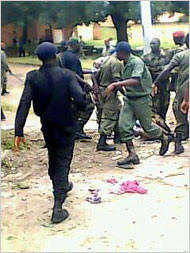
In a cellphone photograph given to The New York Times, soldiers surrounded a woman on the ground on Sept. 28 in Conakry, Guinea. Several images appear to show attacks on women.
In a Guinea seized by violence, women are prey Adam Nossiter New York Times October 4, 2009

Guineans fleeing from the site of the massacre. Photo: BBC
Guinea protests will continue after 150 people killed by army BBC News September 29, 2009 See Hunger Notes special report: harmful economic systems

Health clinics may be free, but they are also very popular. The implementation of the much-acclaimed scheme has been dogged by lack of preparation - both in medical facilities and personnel. Photo: BBC
Burundi's struggle to provide free healthcare Prime Ndikumageng BBC News September 23, 2009

In the absence of a teacher, students discussed their work at a high school in Khayelitsha, on the outskirts of Cape Town. Photo: Joao Silva/New York Times
Eager South African students in poor areas suffer from poor teaching, perhaps a legacy of apartheid Celia W. Dugger New York Times September 21, 2009
China spreads aid in Africa, with some catches (corruption, secrecy and long term indebtedness of the borrowing country) Sharon LaFraniere and John Grobler New York Times September 21, 2009 See Hunger Notes special report on development assistance

Rosaria Chimwaza, a health survey assistant, weighs a baby girl in a Malawi village as her 18-year-old mother looks on. The rate of decline in child mortality for Malawi and six other countries with the highest rates has been much steeper than the global average, according to an analysis by demographers. Perhaps Malawi's most powerful weapon against child mortality has been its ranks of more than 10,000 high-school-educated village health workers. Photo: Moises Saman/New York Times
Child mortality rate declines globally Celia W. Dugger New York Times September 9, 2009
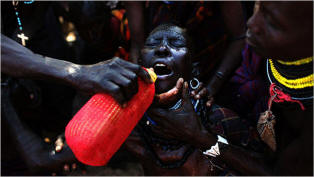
An elderly woman is given water in the Turkana region of Kenya. Many of the elderly are too weak and sick to feed themselves or drink. Photo: Jehad Nga/New York Times More Photos
Lush land dries up, withering Kenya' s hopes Jeffrey Gettleman New York Times September 7, 2009
Gabon protestors clash with security forces after poll result shows Ali Ben Bongo won presidency with 42 percent of the vote. Critics claim election fraud carried out to ensure that Bongo would succeed his father as president. BBC News September 3, 2009

In oil-rich Niger delta, gas flares form the backdrop to everyday life. Residents talk of infections and acid rain due to the flames. Photo: Karin Brulliard/Washington Post
In oil-rich Niger delta, the sun never sets, as smokestacks still shoot out gas flares Karin Brulliard Washington Post August 30, 2009 See Hunger Notes special report Environment and Hunger
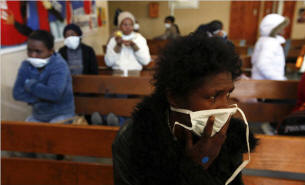
Patients waited at a clinic in Khayelitsha, on the outskirts of Cape Town. South Africa has one of the world’s worst H.I.V. and tuberculosis epidemics. Photo: Joao Silva/New York Times
South African government embraces study very critical of its health policy Celia W. Dugger New York Times August 24, 2009 The Lancet articles on Health in South Africa

One of the world's biggest refugee camps lies on Kenya's border with Somalia. The Dadaab camp, designed to hold 90,000 refugees, now gives shelter to more than three times that number. Photo: BBC
In pictures: Kenya's camp for Somali refugees BBC News August 5, 2009
Nigeria in/near hunger crisis--agriculture is neglected, and 38 percent of children are moderately or severely malnourished David Hecht Washington Post August 2, 2009

Striking South African municipal workers are monitored by police as they protest in Cape Town. Thousands of municipal workers across the country are into their third day of strikes following a breakdown in wage talks with the South African Local Government Assn. Photo: Nic Bothma / EPA
Fed-up South Africans lash out at Zuma's government. Violent protests have erupted in about 20 townships as the urban poor who backed the ANC grow angrier about the lack of improvement to their lives. Robyn Dixon Los Angeles Times July 30, 2009
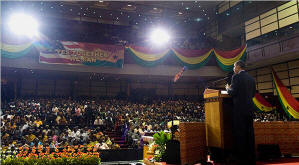
President Obama addressed the Ghanaian Parliament at the Accra International Conference Center on Saturday. Photo: Paul Loeb/Agence France-Presse/Getty Images
Obama gives a call for change to a rapt Africa Peter Baker New York Times July 7, 2009

Supporters rallied Thursday for Malam Bacai Sanhá, a candidate in Guinea-Bissau, where the threat of violence haunts daily life. Photo: Joe Penney/Reuters
Guinea-Bissau, a fragile nation in disarray, holds few hopes for its people as they prepare to vote Adam Nossiter New York Times June 27, 2009 See Hunger Notes special report: harmful economic systems
G8's promise to Africa is likely to be broken--pledge to double aid by 2010 far behind schedule Kathryn Hopkins The Guardian June 11, 2009

Above, a hand-painted anticorruption sign in Lusaka, Zambia. Agencies investigating wrongdoing by powerful politicians have been undermined or disbanded and their leaders have been dismissed, threatened with death and driven into exile. Photo: Mariella Furrer/New York Times
Battle to halt corruption in Africa ebbs Celia W. Dugger New York Times June 9, 2009
Guinea-Bissau, a fragile nation in disarray, holds few hopes for its people as they prepare to vote Adam Nossiter New York Times June 27, 2009 Guinea-Bissau military kills politicians BBC News June 6, 2009
High food prices force Kenyan slum dwellers to go hungry IRIN May 27, 2009 More financial, food, and hunger crisis stories
Can Nigeria's police be reformed? BBC News May 7, 2009
Burkina Faso: largest measles outbreak in more than 10 years IRIN April 9, 2009
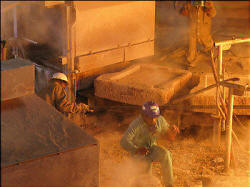
The Indian-owned Konkola Copper Mines in Zambia employs more than 12,000 people, but it plans to lay off nearly 1,100 to cut costs. The mining industry employs 10 percent of Zambia's workforce. Photo: Karin Brulliard/Washington Post)
Zambia's copper belt reels from global crisis--downturn in commodities trade leads to devastating mine closures Karin Brulliard Washington Post March 25, 2009
Study says Pentagon's Africa Command needs to refine mission, citing fears that it will militarize US foreign policy in Africa Eric Schmitt New York Times March 25, 2009
Madagascar president forced out BBC News March 17, 2009

Oscar Kamau Kingara and John Paul Oulu were shot at close range. Two men riddled the car with automatic gunfire and then walked away. The Oscar Foundation, named after its now-dead founder, has been at the forefront of protests about alleged extra-judicial killings by police and Mr Kingara had given the UN evidence of alleged police abuses. Photo: AP
Kenya's power-sharing report card: 'unsatisfactory.' One year after ethnic violence tore the African nation apart, the coalition government is moving slowly – or not at all – to address the problems. Scott Baldauf Christian Science Monitor March 13, 2009 Two human rights leaders shot dead in Kenya--rights groups hold government responsible BBC News March 6, 2009 Rule of law reels in Kenya--killings do not come more cold-blooded and calculated. Oscar Kamau Kingara and John Paul Oulu were shot at close range while their car was standing in traffic just yards from the heavily guarded residence of Kenya's President Mwai Kibaki. Adam Mynott BBC News March 6, 2009

President Joao Bernardo Vieira had ruled intermittently since 1980. Guinea-Bissau is one of the world's poorest states. It has a history of coups and has become a major transit route for smuggling cocaine to Europe. Photo: BBC
Guinea-Bissau president shot dead by soldiers--an apparent revenge attack for the killing of the army chief BBC News March 2, 2009 Guinea-Bissau assassinations: Is Colombia's drug trade behind them? Scott Baldauf Christian Science Monitor March 3, 2009 See Hunger Notes special report: Harmful economic systems
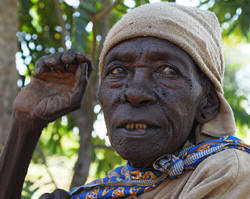
Mary Mwelu, 90, had not had a meal in two days when this picture was taken on 20 January 2009 due to a food crisis that has gripped Kenya Photo: Julius Mwelu/IRIN
Kenya: belt tightening as hunger spreads--causes include violence, high world food prices, and drought IRIN January 21, 2009
Ghana's new leader takes office BBC News January 6, 2009
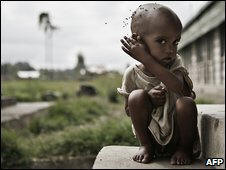
The Ethiopian parliament bill bans aid agencies from working on the rights of children. Temesgen Zewdie, an opposition parliament member sees it as an attempt by the ruling party to banish all those it sees as a threat to its tight grip on power. Photo: AFP
Ethiopia prohibits international aid agencies and Ethiopian NGOs funded by aid agencies from working in areas including human rights, equality, conflict resolution and the rights of children BBC News January 6, 2009