 |
 |
|
|
| DEPARTMENTS | |||

|
|||

|
|||

|
|||

|
|||

|
|||

|
|||

|
|||
| YOU CAN!... | |||
|
|||

|
|||
|
|||
|
|||
| MORE ABOUT HUNGER NOTES |
|||
 |
|||

|
|||

|
|||
|
|||
|
|||
|


Rebuilding New Orleans-- a letter from a visitor
Paula Smith-Vanderslice
(April 11, 2008) Rebuilding New Orleans would take muscle, heart, money, and will after Hurricane Katrina, which made landfall there on Aug. 29, 2005.
What has happened since then is a phenomenon that could not have been predicted, but rather, reflects an entire large city’s struggle to become whole again in the face of overwhelming odds, including a not very functional New Orleans city bureaucracy and a United States disaster assistance agency, FEMA, that was itself in certain important aspects a disaster. An important part of the story of New Orleans rebuilding was the the part played by its low income citizens (predominately African American), assisted in vital ways by non-profit organizations including the American Red Cross and Habitat for Humanity.
I was recently in New Orleans and I had my first chance to see New Orleans as it is rebounding today and compare it with the city I remembered before Katrina hit.
The first thing that struck me after arriving was how odd it seemed that downtown district and major hotels were only several blocks away from an entire encampment of homeless people living underneath the interstate highway I-10. As a native of Washington, D.C., I am accustomed to seeing homeless people everyday, but not living together in tents in such a large population. I was later to learn that it has not been uncommon in New Orleans for very nice homes to abut more “lower class” ones. So, the homelessness near the convention area hotels is a more recent, obvious, and very extreme living condition contrast exacerbated by the hurricane.

 Tim J. Mueller/USA TODAY
The downtown area certainly evinced economic rebound, but was New Orleans’s recovery only in one area of the city? I decided to try to find out.
It soon became apparent to me that it wouldn’t take long to journey from amenities to a lack of them in present-day New Orleans. I only had two days on my calendar before I needed to return to D.C. I would merely scratch the surface, but it would be worth it.
A popular New Orleans bumper sticker slogan these days is, “I drove my Chevy to the levee, but the levee was gone.” How long will the levees, rebuilt since 2005, stand before another Category 5 hurricane tests them? Is the U.S. Army Corps of Engineers doing the best job possible?
Susan Wayman, a local New Orleans tour guide, explained that the storm surge from the “Mr. Go” canal was probably worse than had that canal never been built, as it allowed the water to rush right on through a manmade funnel. However, had the levees never been built around New Orleans itself, the city could never have expanded to its present size.
The downtown area is the oldest part of the city, including the Vieux Carré and French Quarter, and is built on some of the highest ground. It had not relied on levee technology to protect itself from floodwaters. So, it survived the Category 5, while much of the rest of New Orleans flooded.
On Friday night, Bourbon Street seemed even more alive than I remembered it from my last trip in 1998. Big Al Carson sang his heart out at the Funky Pirate. The Cajun Cabin was alive with the two-step, and so was I. I wanted to believe that the city could come back. Here was the soul of New Orleans. Just several days before, however, television had shown us that people who needed housing were not celebrating at City Hall, but were protesting instead.
I was able to sign on for the next day with a construction crew with Habitat for Humanity, a nationwide group dedicated to assisting people in need of a home. Other groups were at the site, also, including AmeriCorps, Camp Hope, and the Baptist Crossroads Project.
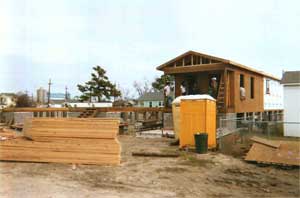
Workers from AmeriCorps, Simpson Baptist Church, Camp Hope, and Habitat for Humanity stand inside the frame of a home they are building in the upper Ninth Ward of New Orleans. Photo: Paula Smith-Vanderslice/Hunger Notes
After arriving at the Musician’s Village site at Alvar and N. Prieur Streets in the Ninth Ward at 7:00 a.m., all volunteers were required to sign a waiver, and briefed on safety considerations. About that time, almost as if on cue, “America the Beautiful” began playing in the distance, and our construction site supervisor explained that one of the local musicians regularly played this song first thing in the morning.
It turned out that “Smoking” Joe, who moves about by wheelchair nowadays, had once played with Fats Domino, the legendary bluesman. He rolled down the street not far away.
We gathered our bibs, helmets, goggles, tools, and ladders, and headed to houses at various stages of completion. The youngest volunteers, and volunteers with no experience in any kind of construction work, are assigned to painting or landscaping jobs for safety reasons. I worked in a house with its foundation and first floor laid, walls up, and windows in, near Herschel, who was cutting boards as Darryl called out measurements. The most experienced volunteers were AmeriCorps workers who had received training in laying radiant barrier, which they proceeded to do across from and above me as I nailed in strong ties adjoining joists where the roof meets the wall.
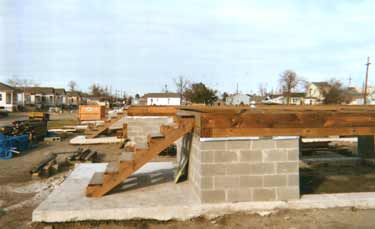
The foundation of a Habitat for Humanity home, at Alvar and North Prieur streets, ninth ward, New Orleans. Photo: Paula Smith-Vanderslice/Hunger Notes
Next, I “toenailed” horizontal blocks between vertical joists in the area where the kitchen shelves would go. I measured the space between the vertical joists using a measuring tape and made a tic mark on loose boards with a pencil. Making sure I was wearing safety goggles, I walked outside to the power saw. I marked the entire width of the board lengths to be sawn through by use of a pivot slide, then cleanly cut the boards with the right amount of pressure on the saw handle. I went back inside and nailed the blocks into place.
At the end of the day, I reflected on my work. I knew that my stepfather, a sheetrock specialist and construction crew foreman who had lived in the Bayou, would be proud if he could see me at work. I was glad I remembered his lessons from when I was a teenager about taking pride in workmanship and showing respect at the level of an apprentice. I noticed that my right middle finger and thumb were sore from all the nails I had hammered into wood. I had emerged from the day unscathed, and had gained a wonderful sense of satisfaction.
For those who lost their homes in flooding following Hurricane Katrina, Habitat for Humanity offers the chance to regain a home for much less than buying a comparable house on the real estate market. By working a total of 350 “sweat equity” hours on a Habitat home, or by paying $6,000 as a down payment, a person who lost his or her home in the flooding can own a Habitat house.
If you’re interested in helping rebuild New Orleans with Habitat for Humanity, see their website at: www.habitat-nola.org
Long-term effects for the people of New Orleans include not only physical displacement, but also psychological displacement, such as depression, and mental and physical illness, understandably more pronounced in those who are still homeless two and one-half years afterward.
Ron Gonzales, executive director of the New Orleans Mission, explained, “The people didn’t start coming back until the end of 2005. Even then it was in small numbers and many of those who came to us were from out of state. We handled the situation by using volunteers and asking those staying in the mission to contribute their time and abilities in the cleanup and recovery effort.”
However, he said that many of those who returned were sick from various diseases, most were depressed and quite a few were suffering from mental illness. “We had no way of knowing exactly what the causes of their infections were, but many did have infections, rashes and open sores.”
“We see mental illness as one of the greatest problems for our homeless, one of the most difficult issues to deal with, and probably the most devastating situation facing long-term recovery,” Gonzales added.
The Mission doesn’t turn away people who need a meal or a bed, unless they are drunk or disruptive, Gonzales said. The New Orleans Mission also partners with the Second Harvest Food Bank of Greater New Orleans and Acadiana. For more information on the Mission’s efforts, visit their website at: www.neworleansmission.org For more information on Second Harvest, visit their website at: www.no-hunger.org
Crime is also on the rise as people return to the city, a further indication of the ongoing mental strain of a population dealing with reduced staffing of sources of formal resource assistance, such as the police department, coupled with homelessness. U.S. Senator Mary L. Landrieu (D-LA), commented on January 29th on the murder the previous day of New Orleans police officer Nicola Cotton, saying, “It has been particularly trying for our law enforcement in the aftermath of Hurricanes Katrina and Rita and the devastating federal levee breaks that followed. I will continue to support our first responders at the federal level so that we can live in communities that are safer both for our people and for those charged with keeping us safe.”
Another issue is health problems resulting from displaced people's living situations. Sen. Landrieu continues to fight for Federal Emergency Management Agency (FEMA) accountability in habitability of trailers on the Gulf Coast that were provided after Katrina. On February 14th, she questioned Homeland Security Secretary Michael Chertoff about the Centers for Disease Control’s (CDC’s) findings of higher than average levels of formaldehyde in the trailers. CDC’s preliminary evaluation of a scientifically established random sample of 519 travel trailers and mobile homes tested between Dec. 21, 2007 and Jan. 23, 2008 showed average levels of formaldehyde in all units of about 77 parts per billion (ppb). Long-term exposure to levels in this range can be linked to an increased risk of cancer, and as levels rise above this range, there can also be a risk of respiratory illness. These levels are higher than expected in indoor air, where levels are commonly only in the range of 10-20 ppb.
FEMA is taking additional steps to expedite the relocation of residents from manufactured housing to apartments or other alternative housing including hotels, motels, and “Katrina cottages.” The priority in relocation will be those occupants expressing a health concern and those most susceptible to health risk such as the elderly, households with young children, and those with respiratory challenges.
FEMA previously announced a plan to close all group sites and relocate residents by June 1st of this year and will continue this activity as part of its ongoing efforts. FEMA has already moved 105,445 households out of temporary housing units as residents return home or move into long-term housing solutions. During the week of February 6, 2008, 983 households moved out of temporary housing and FEMA continues to move between 800 and 1,000 households out, on average, per week.
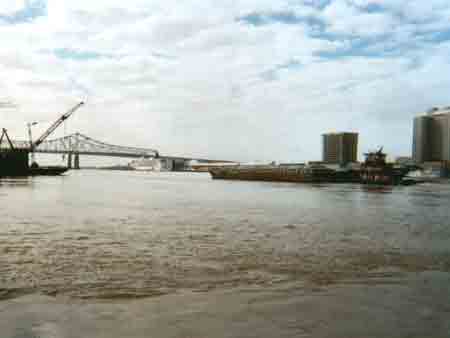
Photo: Paula Smith-Vanderslice/Hunger Notes
I was glad I had a chance to help rebuild New Orleans, even if it was only a day’s worth of work. The following morning, before flying back to DC, I rode on the city transportation system’s ferry across the Mississippi River from New Orleans to the town of Algiers and back. On the water, seeing the beautiful immense flow of the Mississippi, what came to mind was Langston Hughes' poem, ‘The Negro Speaks of Rivers,’
“…I heard the singing of the Mississippi when Abe Lincoln went down to New Orleans, and I’ve seen its muddy bosom turn all golden in the sunset.
I’ve known rivers: Ancient, dusky rivers.
My soul has grown deep like the rivers.”
Even with my scant two days of inquiry, I could see that the souls of African Americans and all those who suffered through the flooding of New Orleans were greatly tested in this latest page of knowing rivers. I could only suspect--and pray-- that it helped their souls to grow deep like the rivers.
Paula Smith-Vanderslice is copy editor for Hunger Notes
Sources:
Federal Emergency Management Agency, “CDC Releases Results of Formaldehyde Level Tests”, Feb. 14, 2008, release number: HQ-08-021.
Hughes, Langston. “The Negro Speaks of Rivers.” New Oxford Book of American Verse, Richard Ellmann (ed.), New York: Oxford University Press, Inc., 1976, p. 694.
New Orleans Area Habitat for Humanity
New Orleans Mission
Press release, Jan. 29, 2008, Sen. Mary L. Landrieu’s office
Sen. Landrieu’s website, Feb. 18, 2008
The Times-Picayune, Feb. 16, 2008, reporter Brendan McCarthy