 |
 |
|
|
| DEPARTMENTS | |||

|
|||

|
|||

|
|||

|
|||

|
|||

|
|||

|
|||
| YOU CAN!... | |||
|
|||

|
|||
|
|||
|
|||
| MORE ABOUT HUNGER NOTES |
|||
 |
|||

|
|||

|
|||
|
|||
|
|||
|


The world financial, food and hunger crisis in 2010
The world food crisis of 2008 was replaced in 2009 in large part by the world financial crisis. In 2010, both crises have resulted principally by the operation of the world economic system and have great impact on people who are poor and hungry. We now add articles to this page that describe the financial crisis, its impact on developing countries, and its impact on poor people. This page is divided into four parts: 2010 articles on the crisis in the United States, 2010 articles on the world crisis, 2009 articles on the crisis in the United States, 2009 articles on the world crisis. Also see 2008 articles on the world crisis.
After years of pressure, major tomato grower joins plan to boost field workers' pay Evan Perez Wall Street Journal October 13, 2010

Nicolle Bradbury bought her home for $75,000 and stopped paying the mortgage two years ago. An advisor for a nonprofit group, Pine Tree Legal Assistance, discovered that no one at her mortgage lender had reviewed the foreclosure documents, as required by law. This led to the understanding that very large numbers of foreclosures had not had propPhoto: Matt McInnis/New York Times
From a Maine house, a national foreclosure freeze David Streitfeld New York Times October 14, 2010
Lack of proper mortgage paper trail could leave big banks reeling again Ariana Eunjung Cha and Jia Lynn Yang
Foreclosure furor rises; many call for a freeze David Streitfeld and Gretchen Morgenson New York Times October 5, 2010
Across the United States, long recovery looks like recession Michael Powell and Motoko Rich New York Times October 5, 2010
Foreclosure furor rises; many call for a freeze David Streitfeld and Gretchen Morgenson New York Times October 5, 2010
TANF is providing assistance to only a small fraction of newly poor families Amy Goldstein Washington Post October 2, 2010
Positive review of stimulus package Lori Montgomery Washington Post October 1, 2010
Recession drove 3.7 million people to Medicare last year Kevin Sack New York Times September 30, 2010
Job loss looms as part of stimulus act expires Michael Cooper New York Times September 25, 2010
Robert Reich: Income gap leading to 'dead' economy Kevin G. Hall McClatchy Newspapers September 24, 2010 See 2010 US hunger and poverty Facts
Poverty in the United States hits record levels and yet there is even more bad news--the recent Census data do not mention key areas of increased poverty Barbara Ehrenreich and Diana Pearce Institute for Policy Studies September 25, 2010
2010 US hunger and poverty facts World Hunger Education Service September 15 2010
Poverty in the United States hits record levels and yet there is even more bad news--the recent Census data do not mention key areas of increased poverty Barbara Ehrenreich and Diana Pearce Institute for Policy Studies September 25, 2010.
The political consequences of stagnation Walden Bello Focus on the Global South September 25, 2010
Recession raises poverty rate to a 15-year high Erik Eckholm New York Times September 9, 2009

Donna Ings took a much lower-paying job as a home health aide after being out of work for over a year. The growth of such low-wage jobs began in the 1980s, accelerated in the 1990s and began to really take off in the 2000s. Losing out in the shuffle are “middle-skill, middle-wage” jobs" — entry-level white-collar positions, like office and administrative support work, and certain blue-collar jobs, like assembly line workers and machine operators. Photo: Michele McDonald for The New York Times
New job means lower wages for many Michael Luo New York Times August 31, 2010 CEOs of top 50 job-cutting companies earned $598 million in compensation last year Diane Stafford Kansas City Star September 1, 1020
Who pays for US and European agricultural subsidies? Farmers in developing countries Timothy A. Wise Tufts University August 19, 2010 See Hunger Notes special report: Trade and hunger
GOP plan to extend tax cuts for rich adds $36 billion to deficit, Congressional panel finds. Democratic plan would increase overall federal tax rate for millionaires to about 29.9 percent, compared with 24.6 percent if all the tax cuts were extended Lori Montgomery Washington Post August 12, 2010 Battle looms on tax breaks for rich as Bush-era tax cuts set to expire Lori Montgomery Washington Post July 26, 2010
House passes, Obama signs, bill with $26 billion in aid to school districts and states to prevent large-scale layoffs of teachers and public employees Carl Hulse New York Times August 10, 2010 Food stamp funding was cut to provide state aid Jonathan Allen Politico August 10, 2010

For longtime jobless, no more help in sight Michael A. Fletcher Washington Post July 13, 2010
Stringent requirements have limited Temporary Assistance to Needy Families to families in spite of high unemployment Robert Pear New York Times April 6, 2010
In a poor area of Washington DC, residents struggle to find jobs. Dana Hedgpeth Washington Post June 18, 2010

Tyrone Banks in his home in Memphis. He is in danger of losing it after the payments on his mortgage rose and he lost his job at FedEx. Photo: Josh Anderson/New York Times
The new poor: Blacks in Memphis lose decades of economic gains Michael Powell New York Times May 30, 2010
State budget problems hinder expansion of health insurance for poor children USA Today May 25, 2010
Arizona becomes the first state to eliminate its state children's health insurance program (S-CHIP) due to budget difficulties--more than 47,000 poor children will now be without coverage Kevin Sack New York Times March 18, 2010
Millions of Americans are out of work, out of savings, and at the end of their unemployment compensation, with no jobs in sight Peter S. Goodman New York Times February 18, 2010
States consider Medicaid cuts as use grows Kevin Sack and Robert Pear New York Times February 18, 2010
Once stigmatized, food stamps find acceptance Jason DeParle and Robert Gebeloff New York Times February 10, 2010
World hunger dips, but not by much IRIN News September 14, 2010 Also see Hunger Notes 2010 world hunger and poverty facts

Russians fought a fire near the village of Golovanovo, in the Ryazan region of Russia on Thursday. Dry conditions have led both to failure of the wheat crop and widespread forest fires over a large region. Photo: Natalia Kolesnikova/Agence France-Presse — Getty Images
Russia bans grain exports after millions of acres of wheat wither in severe drought Andrew E. Kramer New York Times August 5, 2010 Wheat prices reach 22 month high--up 50 percent since June due to severe drought in Russia BBC News August 3 2010
World Bank warns on farmland grab: Foreign investors target countries with weak laws, buying arable land on the cheap and failing to deliver on promises of jobs and investments Javier Blas Financial Times July 27, 2010 See Hunger Notes special report Harmful economic systems especially the section on international aspects
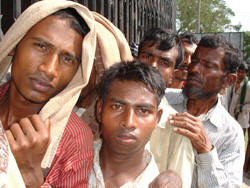

Men queue for food assistance in the wake of Cyclone Sidr. Along with India, Bangladesh has the highest proportion in the world of newborns with low birth weight. Micronutrient malnutrition is also at alarming levels in Bangladesh, affecting nearly 30 million women and 12 million children under five years old. Photo: David Swanson/IRIN
Bangladesh: Unemployment, food prices, high population growth spur growing hunger IRIN July 22, 2010
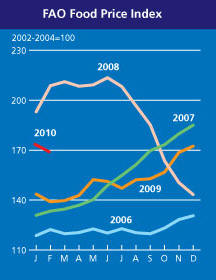
This graph shows (an index of) the price of food in various years, with the average price for 2002-2004 taken as 100. The graph shows that from February to August 2008, food prices were 200 percent or more of the the base years of 2002-2004. In 2010, the graph shows that food prices are still 70 percent greater than the average of 2002-2004. For most hungry people (other than those in zones of conflict or natural disaster) the price of food is critical. When prices are high, food is available, just not affordable, and they go hungry. An estimated 16 million people go hungry for every one percent increase in the price of staple foods.
Are we heading for another food crisis? IRIN News March 2, 2010

According to data issued this month by the U.S. Department of Agriculture, the number of children living in homes without enough food soared in 2008 from 13 million to nearly 17 million. Photo: Mark Gail/Washington Post
Child hunger, called the 'silent epidemic,' is an increasingly complex problem Amy Goldstein Washington Post December 12, 2009
Obama preparing new push to add jobs, tackle deficit David Cho and Michael A. Fletcher Washington Post December 8, 2009 A plea to Congress on jobless benefits Eric Eckholm New York Times December 7, 2009 Obama turns to unemployment and job creation, but warns of limited funds Jackie Calmes New York Times December 3, 2009

Greg Dawson considers himself lucky to still have work, as a night-shift electrician installing lights in a chain of grocery stores. He lives in the house he's building in Martinsville, Ohio, with his wife, Sheila, and their five children, and they get a $300 benefit through the food stamps program. "It's embarrassing," said Mr. Dawson, 29. "I always thought it was people trying to milk the system. But we just felt like we really needed the help right now." Photo: Stephen Crowley/The New York Times
Across the United States, food stamp use soars and stigma fades--program now helps feed one in eight Americans and one in four children Jason DeParle and Robert Gebeloff New York Times November 28, 2009 More photos
Nearly 50 million people in the United States -- including almost one child in four -- struggled last year to get enough to eat, Department of Agriculture says Amy Goldstein Washington Post November 17, 2009
US unemployment rate hits 10.2%; broader unemployment measure (including discouraged workers and part-time employees who want to be full-time) reaches 17.5% David Leonhardt New York Times November 6, 2009 Why won't the Obama administration pay people to work? Alec MacGillis Washington Post November 8, 2009 (opinion)

Shane Palmer, right, kisses his fiancé, Maria Maior outside the storage unit they are living in with her 12-year-old son in a northwest Chicago suburb. The family of three splits time between their storage unit and motels following a job loss and a string of bad luck. Photo: David Pierini/ Chicago Tribune
Homeless students: increasingly, families taking shelter anywhere they can Bonnie Miller Rubin Chicago Tribune October 28, 2009 See more videos and pictures on hunger and poverty in the United States

Clinton Anchors, 18, in Medford, Ore., has been on his own, living in the streets and camping in the woods since he was 12. Photo: Monica Almeida/The New York Times
Recession drives surge in youth runaways Ian Urbina New York Times October 5, 2009 How teens in Medford Oregon who have left home get by (video) See more videos and pictures on hunger and poverty in the United States
As unemployment rises, Obama aides consider 'safety net' options Jackie Calmes New York Times October 5, 2009

After losing their jobs, Scott and Kelly Nichols watched their finances and options dwindle, eventually making the tough decision to move their family to Kelly's mother's basement in Michigan. Photo: Washington Post See article for further pictures
For many Americans, nowhere to go but down Paul Schwartzman Washington Post August 5, 2009
Unemployment insurance is about to end for 1.5 million Americans, for many their last bulwark against foreclosures and destitution Eric Eckholm New York Times August 1, 2009

Steven Sullivan, right, was given a job with the Tennessee Department of Transportation after Perry County received federal stimulus money. Photo: Josh Anderson/New York Times
US stimulus package actually creates jobs in one Tennessee county through use of Temporary Assistance to Needy Families (TANF) funds--jobless rate drops to 22 percent Michael Cooper New York Times July 27, 2009
Jobless checks for millions delayed as states struggle Jason DeParle New York Times July 23, 2009

The Maldonado family had been living without gas, electricity or hot water, but did not move out until the school year ended. Photo: Rob Bennett/New York Times
Summer brings a wave of homeless families Julie Bosman New York Times July 7, 2009
Too poor to make the news Barbara Ehrenreich New York Times June 13, 2009
Nearly 20 million students now receive free or low cost school lunches, an all time high. Many school districts struggle to cover their share of the meal's rising costs. Peter Eisler and Elizabeth Weise USA TODAY June 11, 2009

A foreclosed home on Barclay Street in Baltimore. The city is suing Wells Fargo Bank over its mortgage lending practices in black neighborhoods. Photo: Matt Roth/New York Times
Wells Fargo bank accused of pushing high-interest subprime mortgages on African Americans in Baltimore Michael Powell New York Times June 6, 2009

Video: Homeless victims of credit crunch Across the US, a new generation of homeless has been created by the credit crunch. Families have lost their homes, and with no safety net, more and more are entering the shelter system. Dumeetha Luthra went to the Bronx and followed Kara Gonzalez and her five children as they move to their third shelter since losing their home last June. Dumeetha Luthra BBC News
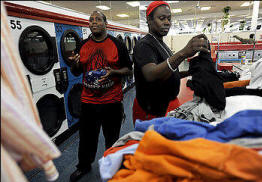
Time is money, and both are in short supply: Quintin Strange, left, and Kenneth Thomas say they've cut back their weekly laundering to every third week because of the recession. Photo: Lois Raimondo/Washington Post)
It's expensive to be poor! No car, no washing machine, no checking account and no break from fees and high prices! DeNeen L. Brown Washington Post May 18, 2009
The global financial crisis and its effect on poor people in the United States (shunted aside in times of prosperity and even more during recession) Lane Vanderslice Hunger Notes May 17, 2009

One location where a Chicago food bank is helping feed people that need food. Photo: BBC See complete video
Poverty hits African Americans hard BBC News April 23, 2009 See video
One in 50 children now homeless Cynthia Hubert Sacramento Bee March 10, 2009
US downturn dragging world into recession Anthony Faiola Washington Post March 9, 2009
Texas Gov. Rick Perry rejects stimulus money for jobless claims, citing unacceptable rule changes that would broaden who may receive unemployment benefits Christy Hoppe and Robert T. Garrett Dallas Morning News March 13, 2009 US unemployment rate leaps to 8.1 percent--highest since 1983 Neil Irwin and Annys Shin Washington Post March 7, 2009 Both parties love big government: Ronald Reagan increased government spending by 69 percent, Bill Clinton by 32 percent, and George W. Bush by 68 percent Steven Thomma McClatchy Newspapers March 5, 2007 Obama's budget: taxing for fairness or class warfare? Maura Reynolds Los Angeles Times February 28, 2009 Battle lines quickly set over planned policy shifts: budget, in addition to addressing financial crisis, also marks largest ideological swing since Reagan era Lori Montgomery Washington Post March 1, 2009 Economy shrinks at staggering rate Annys Shin and Neil Irwin Washington Post February 28, 2009

World cereal production is at its second-highest level ever, yet food prices remain very high. In Asia for example, prices are up 40-70 percent. Photo: Kamila Hyat/IRIN
World hunger increases despite growth in food production IRIN News November 12, 2009 We can have food security, say two new reports IRIN News November 12, 2009
200 million children under the age of five in the developing world suffer from chronic undernutrition, causing one-third of deaths in children under five, the United Nations Children's Fund says BBC News November 11, 2009 Access UNICEF report and video
Food experts worry as population and hunger grow Neil MacFarquhar New York Times October 21, 2009 Economy has left 1 billion hungry, UN says Ariel David Associated Press/Boston Globe October 15, 2009
The world food crisis: what is behind it and what we can do? Eric Holt-Giménez Food First October 23, 2009
Who is to blame for rising hunger? Al Jazeera September 21, 2009 (Video) (Inside Story presenter Maryam Nemazee discusses with Bettina Luescher, a spokesperson for the United Nations World Food Programme, Christina Schiavoni, a co-director of Global Movement at whyhunger.org and an organizer at the US working group on the global food crisis, and Firoze Manji, the founder and executive director of Fahamu, an African social justice network.)
The global food price crisis: a critique of orthodox perspectives Walden Bello Focus on the Global South June 28, 2009
Economic crisis could last years Al Jazeera June 25, 2009 More financial, food, and hunger crisis stories
Bumper crop, but Zimbabwe hungry BBC News June 25, 2009 More Zimbabwe stories
One billion people throughout the world suffer from hunger, a figure which has increased by 100 million because of the global financial crisis, UN says BBC News June 19, 2009
High food prices force Kenyan slum dwellers to go hungry IRIN May 27, 2009
The real hunger crisis--persistent poverty in rural Africa and South Asia Robert Paarlberg Foreign Affairs May 24, 2009
Tanzania's ruling elite neglect agriculture and poor farmers Ng’wanza Kamata University of Dar es Salaam May 24, 2009
Food prices remain high in developing countries Food and Agriculture Organization April 23, 2009
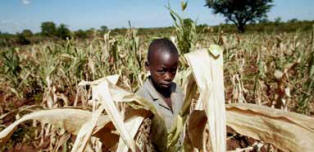
A boy stands in parched corn field near Harare, Zimbabwe. Photo: Associated Press
Could food shortages bring down civilization? The biggest threat to global stability is the potential for food crises in poor countries to cause government collapse. Lester Brown Scientific American May 2009

The Indian-owned Konkola Copper Mines in Zambia employs more than 12,000 people, but it plans to lay off nearly 1,100 to cut costs. The mining industry employs 10 percent of Zambia's workforce. Photo: Karin Brulliard/Washington Post)
Zambia's copper belt reels from global crisis--downturn in commodities trade leads to devastating mine closures Karin Brulliard Washington Post March 25, 2009

Malnutrition in India is worse than in many African nations, stunting the growth of children like this girl in Shivpuri, photographed in November 2008. Photo: Ruth Fremson/The New York Times
As Indian growth soars, child hunger persists Somni Sengupta New York Times March 13, 2009 India struggles with hunger Nancy Donaldson and Ruth Fremson New York Times (Audio slide show) (Among other virtues, an excellent brief description of how hunger affects children.)
US downturn dragging world into recession Anthony Faiola Washington Post March 9, 2009
CIA adds global financial crisis to daily threat updates for President Obama: growing CIA belief that economic meltdown is now principal security threat Joby Warrick Washington Post February 26, 2009
First salvos of trade wars as worldwide recession deepens Anthony Faiola Washington Post February 1, 2009

Mary Mwelu, 90, had not had a meal in two days when this picture was taken on 20 January 2009 due to a food crisis that has gripped Kenya Photo: Julius Mwelu/IRIN
Kenya: belt tightening as hunger spreads--causes include violence, high world food prices, and drought IRIN January 21, 2009
2008 articles on the world financial, food and hunger crisis