 |
 |
|
|
| DEPARTMENTS | |||

|
|||

|
|||

|
|||

|
|||

|
|||

|
|||

|
|||
| YOU CAN!... | |||
|
|||

|
|||
|
|||
|
|||
| MORE ABOUT HUNGER NOTES |
|||
 |
|||

|
|||

|
|||
|
|||
|
|||
|


Want to see corruption in Zambia? Take a taxi!
(March 20, 2007) You are likely to encounter a roadblock, where a traffic officer expects a bribe to let your taxi or minibus pass. Or you may be forced to jump off the bus and wait by the roadside while the driver zooms off to settle a deal with a policeman.
In Zambia, as in many countries, the poorer you are, the more likely you are to depend on minibuses and shared taxis to get around and so the more likely you are to be affected by the corrupt transport system.
Those with their own cars are also affected. If they are stopped for a traffic violation – whether or not they have committed an offence – they know that it’s cheaper to pay the police officer a bribe than to be forced to pay an official fine through the government system.
Over the years, endemic corruption has been a major factor in the decline in Lusaka’s transport system. Despite endless complaints in the media and elsewhere, the government has failed to tackle the problem.
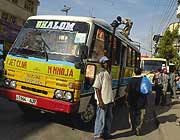
A typical journey might proceed as follows: a packed minibus is driving along when the sound of a police siren gets closer and the minibus is pulled over.
Commuters are then told to get out of the minibus and a traffic officer jumps in. The driver and the traffic officer then drive off together to settle the bribe, leaving the passengers by the side of the road.
Without much fuss, the commuters try to catch another minibus heading in their direction. It’s a daily scene in Lusaka. Sometimes a driver runs away, and a traffic officer chases after him on a motorbike. And sometimes a traffic officer jumps into the front seat of a taxi.
I spoke to minibus drivers and traffic officers to uncover the chain of corruption.
“I would rather grease the palm of the road traffic officer with US$10 and evade the heavier official fine of US$85 that I would be charged for the offence,” says Thomas Ndeke, a minibus driver.
“We end up making traffic officers rich while going hungry ourselves – but we avoid paying higher fees at the police stations,” he adds.
Over a dozen minibus drivers, who prefer anonymity for
fear of harassment from the traffic officers, concur
with Ndeke.
“Bus drivers are the most harassed. We do not know what
crime we have committed against the government. It is
like we only work for the police. I cannot even afford
to buy a new tyre,” complains a bus owner and driver.
“Traffic officers will usually give you either a genuine
charge or a fake one and demand a tip. Sometimes we are
charged for no reason,” says another.
Many drivers say they will continue to pay bribes until
the government reduces its traffic fines, which drivers
consider exorbitant.
Machova Musanshi, a motorist in Lusaka, says that both
motorists and traffic officers are to blame. He points
out that although motorists have the right to refuse to
pay bribes, it is cheaper and more convenient to cough
up the money. He says that traffic officers are poorly
paid and need the money.
“As much as we should be in the forefront of curbing corruption, our salaries and conditions of service are so poor that we have to find other ways to earn a living,” says one police officer, who wishes to remain anonymous.
Many police officers live in squalid townships or end up
sleeping in makeshift shacks or even horse stables. They
struggle to meet their children’s school fees.
“Delays in paying salaries, lack of uniforms,
accommodation, transport and other necessities are some
of the factors contributing to officers’ low morale,”
says Sylvester Tempo, general secretary of Zambia
Congress of Trade Unions (ZCTU).
Tembo says anti-corruption strategies need to take in to
account the economic reasons why traffic officers are
soliciting bribes, and feels people should not be quick
to condemn.
But Ephraim Mateyo, inspector general of police, warns that no mercy will be shown to traffic officers involved in criminal and corrupt activities and has appealed to the public to report such officers. There is a general view that police corruption is undermining public confidence in public services.
Donors and the international community have strongly
emphasised the need for governments in aid-receiving
countries to ensure a system of good governance and
transparency. They warn that without progress in these
areas they may suspend aid.
But in Zambia, the demand for good governance is not
only a condition imposed by donors – it is what most
people want.
Jubilee Zambia, one of the country’s leading
anti-poverty groups says that “the people of Zambia are
calling for good governance and an end to corruption.
They demand more effective use of public resources for
road construction, better health and education systems,
timely access to information and space to participate in
decision making.”
In order to break the cycle of poverty and corruption,
Jubilee Zambia has called on the government to make its
Anti-corruption Commission (ACC) an autonomous body so
it can investigate corruption cases more effectively,
particularly where government officials are involved.
It says a solution would be to enforce severe punishment on those involved in corruption while providing sufficient remuneration to government officers. It also says that forming a strong and honest alliance between government departments and the private sector is essential.
This article originally appeared in
Panos
and may be viewed at http://www.panos.org.uk/newsfeatures/featuredetails.asp?id=1285