 |
 |
|
|
| DEPARTMENTS | |||

|
|||

|
|||

|
|||

|
|||

|
|||

|
|||

|
|||
| YOU CAN!... | |||
|
|||

|
|||
|
|||
|
|||
| MORE ABOUT HUNGER NOTES |
|||
 |
|||

|
|||

|
|||
|
|||
|
|||
|


AIDS Threatens Poor Farmers in Mozambique
(Rome, August 23, 2004) HIV/AIDS is threatening
subsistence agriculture in Mozambique with long-term
decline, a trend that has ominous implications for the
country's food supply, FAO warned today.
A major new study of subsistence agriculture in
Mozambique documents the loss of many varieties of
grains, tubers, legumes, and vegetables due to HIV/AIDS,
floods, and drought, according to FAO.
Alarming trend
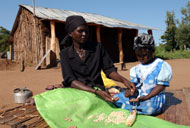
Photo: FAO
Rameca Mungwe shows her daughter Veronica how to select the best maize seeds.
The disease is impoverishing agricultural households. The
study shows that 45 percent of respondents from
HIV/AIDS-affected households said they had reduced the area
under cultivation and 60 percent said they had reduced the
number of crops grown.
"This study documents an alarming trend affecting millions
of the poorest rural households. The problem affects not
only Mozambique but also countries across southern and
eastern Africa, where HIV/AIDS is just as big a problem,"
said FAO HIV/AIDS expert Marcela Villarreal.
Loss of Farming Know-how
Study author Anne Waterhouse said the results showed that
HIV/AIDS is likely to have a "highly negative" impact on
local knowledge around seeds because it affects the passing
of farming know-how about traditional crops from generation
to generation as infected adults slowly become incapacitated
and stop planting many varieties of crops.
"Most of the farmers use seeds that they produce themselves
to grow their own crops; the way they pass on knowledge
about how to identify, improve and conserve that seed is
from parent to children," she said. "So what happens if you
stop producing a certain seed type is that the knowledge
around it is not passed on."
It is important not to lose traditional crop varieties
because they act as an insurance policy against hunger since
they are adapted to local conditions and will produce a
minimal harvest even during Africa's recurrent droughts.
Moreover, hybrid or "improved" seeds, which do not withstand
drought as well as traditional seeds, require inputs, such
as fertilizer and plentiful water, that are often beyond the
means of the poorest farmers.
In Mozambique, more than 1.3 million people out of a
population of 18 million are thought to be living with
HIV/AIDS. FAO predicts that by 2020 the country will have
lost over 20 percent of its agricultural labor force to
HIV/AIDS. In the nine hardest-hit African countries, all in
southern and eastern Africa, FAO predicts a loss of
agricultural labor because of the disease, ranging from 13
percent in the United Republic of Tanzania to 26 percent in
Namibia.
The Mozambique government estimates that over 600,000
children have been orphaned by the disease. In response to
the orphan crisis, FAO is field-testing ways to help the
children learn farming and life skills.
The study, which interviewed about 90 men and women in three
communities in Chokwe District, Mozambique, in late 2003,
was commissioned by the FAO LinKS project, which explores
the linkages between local knowledge, gender, and
biodiversity, and was conducted by the International Crops
Research Institute for the Semi-Arid Tropics.
The United Nations Food and Agriculture Organization is the part of the United Nations that deals with food and agriculture. Its interesting website can be visited at www.fao.org. The original of this article can be seen at http://www.fao.org/newsroom/en/news/2004/49917/print_friendly_version.html